Your questions answered: ‘Which is the most successful species of ant?’

Noah contacted us recently with an intriguing question: ‘What is the most successful species of ant?’. It really got us thinking! Insects are a very successful group of animals, and ants are very successful insects, but how could we decide which is the most successful?

There might be different ways we might measure success. It is the most numerous ant? Or the group with the most species? It might be the species that’s most widely spread across the globe? Perhaps it’s the longest-lived, or the largest?

Successful ants

Ants are a very successful group of insects. The biologist E.O. Wilson (who died recently) estimated that there may be a million ants for every human being, but the truth is that we don’t really know. Although they are small, there are so many of them that they may make up a quarter of the mass of all land animals!

Scientists think that ants probably evolved from a type of wasp 168 million years ago. They became really successful after flowering plants evolved about 100 million years ago. We know this because ants appear much more often in the fossil record, and we start to find many more species . One of the oldest fossil ants is Sphecomyrma, found trapped in 99 million year old amber from Myanmar.
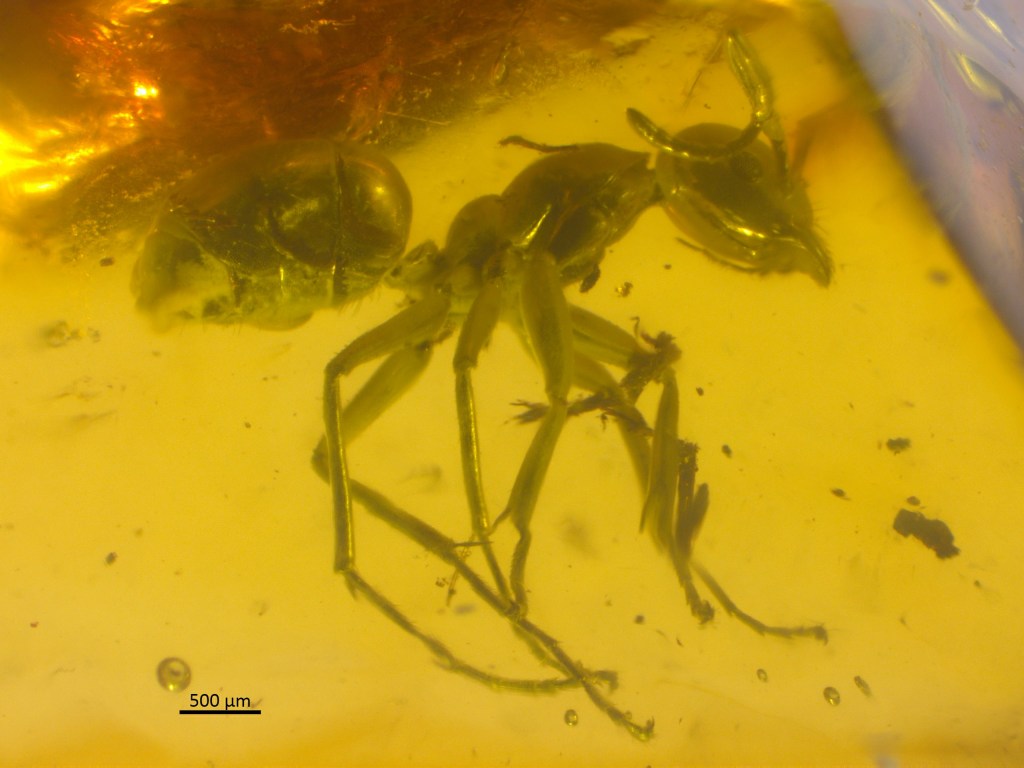
Micrograph of a fossil ant trapped in amber. Species undetermined. 50 million years old.
Fossil Ant trapped in Amber. Image Credit: OUMNH

Features that have helped ants to become so successful include:

  • Their social nature – ants in a nest are good at cooperating.
  • They modify habitats – most animals can only survive in certain conditions but ant colonies can change their surroundings to suit them.
  • Ants can use a wide range of food sources. Some species even farm – growing fungi or ‘milking’ aphids for food.
  • Defence – ants are really good at defending themselves and each other. They are strong, have biting mouthparts and produce acid. The origin of the word ‘ant’ means ‘biter’.
  • Some species form supercolonies – huge nests containing several queen ants. This level of cooperation and organisation help some ant species to be mega-successful.
The ability of ants to cooperate helps make them successful.

Which ants are most successful?

So, ants are very successful as a group of insects. Here are some examples of ant species that might be the most successful:

Most numerous: Difficult to say, but perhaps the Argentine ant Linepithema humile.

Widest distribution: Several contenders for this, but perhaps the fire ant Solenopsis invicta.

Most different species: The genus Pheidole with over 1,000 described species.

Largest: The fossil giant ant Titanomyrma gigantuem was the largest ant to have lived. The queens were 6cm long with a wingspan of 15cm.That’s about the same size as a hummingbird!

Longest lived: We think oldest individual ant on record in a laboratory was a queen of the species Pogonomyrmex owyheei which lived to be 30 years old. Colonies of ants can survive for centuries in nature, continuing through many generations of ants.
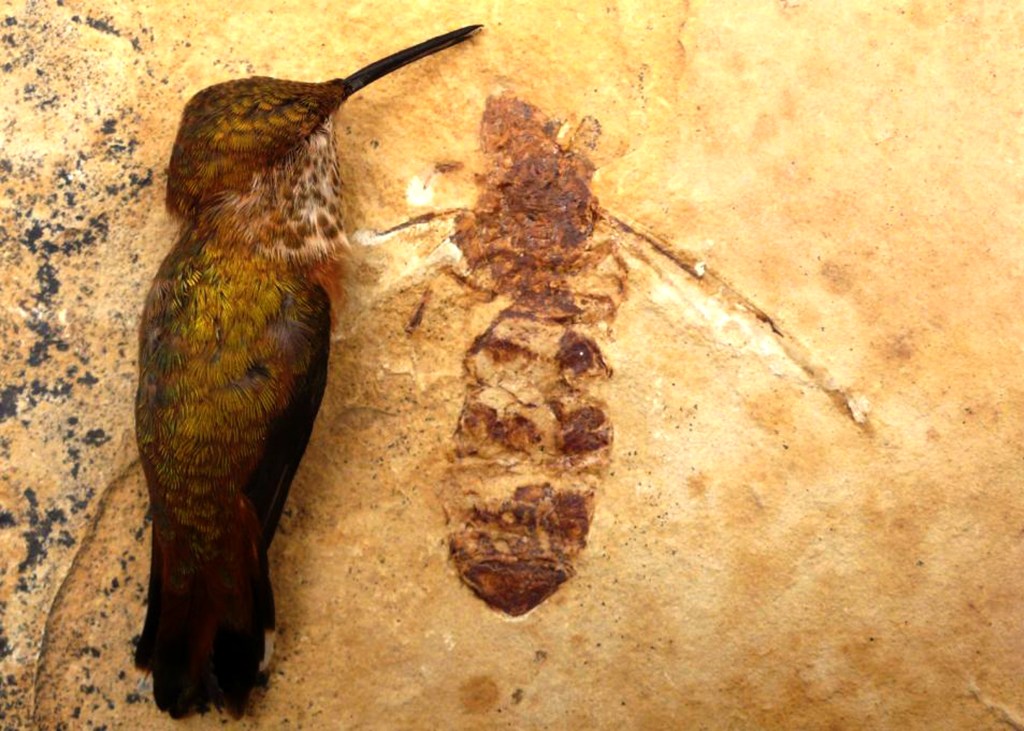
The fossil giant ant Titanomyrma lubei, with a hummingbird for comparison.
Image Credit: Simon Fraser University CC BY 2.0

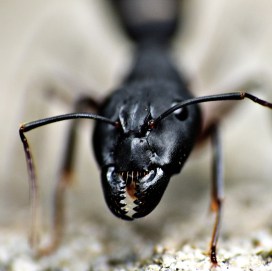
The fact is, however, that every species has most of the characteristics that make all ants successful, so perhaps the most common British ant, the Common Black Ant, Lasius niger, is as good a candidate for most successful as any? It’s also worth remembering that entomologists think we have only described about two thirds of all ant species – so there are many more left to discover!

We hope that answers Noah’s question. If you have a question about insects or the museum you’d like to ask us, just write it in the comments or send us a message using the Contact Us page.
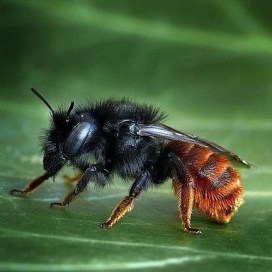
The Red Tailed Mason Bee

You may well have noticed some bees recently. One of the earliest solitary bees to emerge in spring is the Red Tailed Mason Bee, Osmia bicolour. They are very distinctive and make their nests in a very particular place.

The males emerge first, sometimes as early as March. They have yellowish bands. They are the followed in a couple of weeks by females which have distinctive red-banded abdomens, giving this bee its common name. The adults may continue flying well into July, so you have plenty of time to spot them. This species of bee is mainly found across southern England and the Midlands and South Wales. This is because it prefers chalk and limestone grassland and so is mainly in areas with this type of habitat.

Female Red Tailed Mason Bee making a snail shell nest. Copyright © John Walters, used with kind permission.

The Red Tailed Mason Bee is unusual in that the females make their nests in empty snail shells. A female bee works diligently to select a suitable shell then prepare the nest. She will then defend this vigorously. She will make several cells within the spiral of one shell, laying an egg in each cell. She will provide each egg with pollen as food for the larvae when they hatch. She will separate each cell with a glue-like substance called mastic. She makes this by chewing up pieces of leaf. When the nest is completed, she will plug the shell with more mastic and will then search for debris such as grass stems, fallen leaves and pine needles to carefully cover and camouflage it. She may also spread more mastic over the outside of the shell.

Entomologists think it is likely that this behaviour protects the shell and its contents from parasites and predators. Safe inside, the eggs will hatch and the larvae will develop inside the shell, feeding on their supply of pollen. They will then survive the winter as pupae, emerging as the next generation of adults the following spring.

So, if you spot an old snail shell, it’s worth keeping an eye on it; it may just become a nest for a Red Tailed Mason Bee. We’d love to hear about your bee sightings and to see your pictures. Get in touch with us using the comments below or by the Contact Us page.

Header image: Red-tailed mason bee, Osmia bicolor female. Image: František ŠARŽÍK CC BY 3.0

Red-Tailed Bumblebee

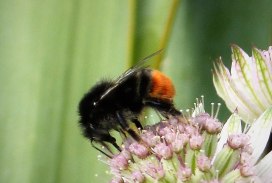
If you see a big jet-black bumblebee with a red tail in Britain, its probably the Red-tailed Bumblebee, Bombus lapidarius. If it has a scruffy white collar, then its a male.

The Red-tailed Bubmblebee has extended its range northwards in recent years and is now common throughout Britain. It can often be seen in parks and gardens. The workers have short tongues and forage on flowers like daisies and thistles which have a big area for them to land on and are made up of small florets, each with a little nectar. Leaving dandelions to grow in the spring helps provide food for these and other insects early on in the growing season.

Let dandelions grow in spring to help insects. Image credit: Pixabay / Claudiu Mladin CC0

The Queens nest under stones and so are sometimes disturbed when these are moved. If you find one like this, have a look without disturbing it then just put the stone back. They may also enter our homes through open windows in search of nesting sites.

The Red-shanked carder bee, Bombus ruderarius, can look similar but is much scarcer in the UK. While the Queens of B. ruderarius are smaller. the workers of the two species can be a similar size. You can tell the difference by looking at the back legs. B ruderarius has red pollen baskets on its otherwise black legs, whereas the leg hairs of B. lapidarius are all black.

Lincoln Kwong was one of the participants at our Summer school in August. He was so inspired by the HOPE collections team at the museum that he decided to start his own insect collection. One of his first specimens was a dead red-tailed bumblebee that he found in his garden. He preserved and pinned this and recorded the data following advice from James.

Bombus lapidarius. Image credit: Lincoln Kwong

Let us know if you have your own collection. You can get in touch using the CONTACT US page. We’d also love to see any pictures any would be happy to feature them in our PHOTO GALLERY!

Featured image credit: Gail Hampshire CC BY 2.0