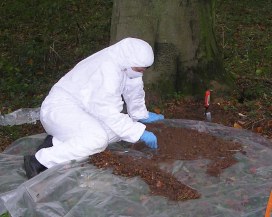
How can insects help solve crimes? In this video, forensic entomologist Dr Amoret Whitaker discusses her work and how she came to work with some common flies that can provide important clues.
The blow flies that Dr Whitaker talks about are a family of flies (Diptera) called the Calliphoridae. They often have bodies with a metallic sheen and are also known as carrion flies, bluebottles and greenbottles. The fly pictured in the video is Cynomya mortuorum, known as the yellow-faced fly or sometimes, more gruesomely, as ‘the fly of the dead’.
Forensic entomology is just one way in which scientists work with insects. If you would like to know more about different entomologists and what they do, visit the People section of the blog.
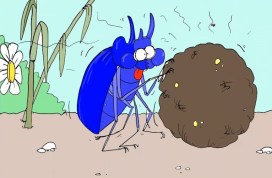
Previously, Chris Jarvis showed us how to draw a mighty Minotaur Beetle (Typhaeus typhoeus) complete with its own ball of dung! In this video Chris returns to add some finishing touches to this picture. He shows us how to convey the size of the beetle, and how to use colour to great effect.
We’d love to see any pictures you draw of insects, whether it is an ant, bee, caterpillar or your very own Minotaur beetle. Share with us at hopelearning@oum.ox.ac.uk.
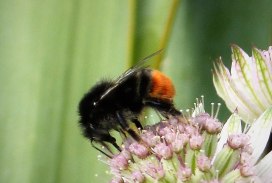
If you see a big jet-black bumblebee with a red tail in Britain, its probably the Red-tailed Bumblebee, Bombuslapidarius. If it has a scruffy white collar, then its a male.
The Red-tailed Bubmblebee has extended its range northwards in recent years and is now common throughout Britain. It can often be seen in parks and gardens. The workers have short tongues and forage on flowers like daisies and thistles which have a big area for them to land on and are made up of small florets, each with a little nectar. Leaving dandelions to grow in the spring helps provide food for these and other insects early on in the growing season.
Let dandelions grow in spring to help insects. Image credit: Pixabay / Claudiu Mladin CC0
The Queens nest under stones and so are sometimes disturbed when these are moved. If you find one like this, have a look without disturbing it then just put the stone back. They may also enter our homes through open windows in search of nesting sites.
The Red-shanked carder bee, Bombus ruderarius, can look similar but is much scarcer in the UK. While the Queens of B. ruderarius are smaller. the workers of the two species can be a similar size. You can tell the difference by looking at the back legs. B ruderarius has red pollen baskets on its otherwise black legs, whereas the leg hairs of B. lapidarius are all black.
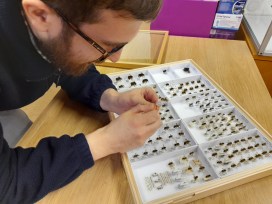
Lincoln Kwong was one of the participants at our Summer school in August. He was so inspired by the HOPE collections team at the museum that he decided to start his own insect collection. One of his first specimens was a dead red-tailed bumblebee that he found in his garden. He preserved and pinned this and recorded the data following advice from James.
Bombus lapidarius. Image credit: Lincoln Kwong
Let us know if you have your own collection. You can get in touch using the CONTACT US page. We’d also love to see any pictures any would be happy to feature them in our PHOTO GALLERY!
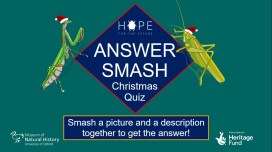
To round off an eventful year here at Crunchy on the Outside, we have put together a quiz for you combining our two favourite things: Insects and Christmas!
There are ten questions in the video. Each of the answers is formed by smashing together the two clues. One clue is about insects, the other about Christmas. We’ve included a couple of examples at the start to help you get the hang of it. Don’t worry if a question seems tricky, it’s just for fun and we’ve included some clues below.
Clues
The scientific name of this insect is Colletes hederae.
Louis is a Collections Assistant, for the HOPE for the Future Project, at Oxford University’s Museum of Natural History. Here he is telling us about his role and how he first became interested in insects.
Louis mentions that through his job he gets to see rare and extinct insects that you normally might not get the chance to see. Can you tell us about any rare or extinct insects that you know about? Let us know in the comments below, or through the contact us page.
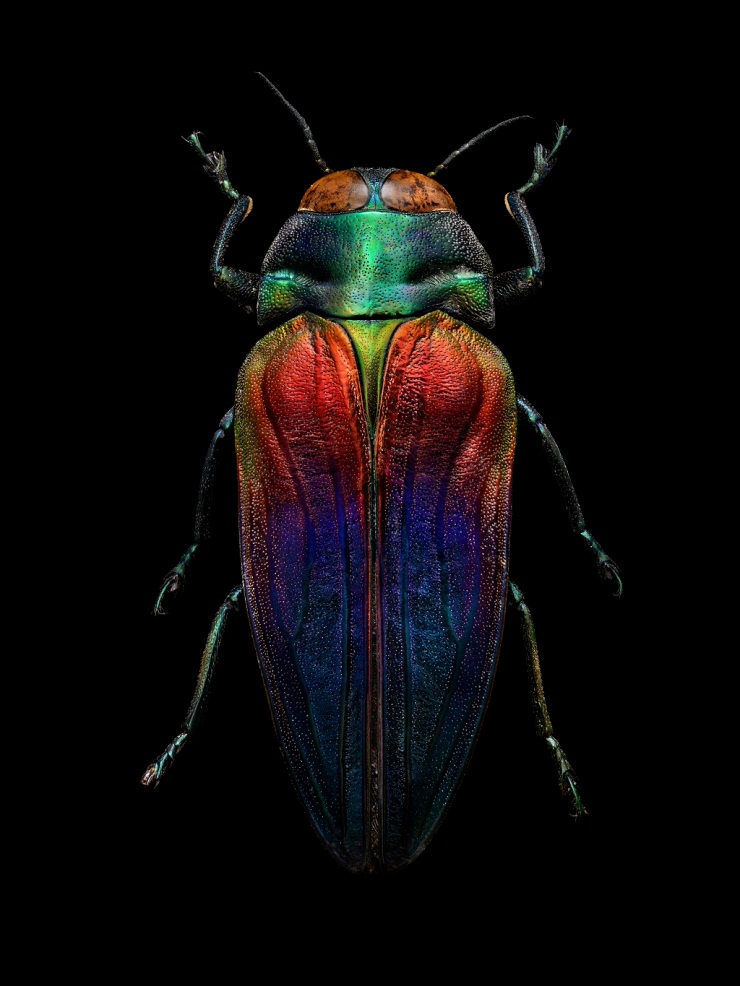
On the first floor of the Oxford University Museum of Natural History, at one end of the insect gallery, by the café, is an interactive screen. This displays one of my favourite parts of the insect gallery. The wonderful world of Microsculpture. This was originally an exhibition in the museum, Microsculpture: The Insect Photography of Levon Biss, which was open in 2016. You can still see the remarkable images from the exhibition on the screen in the gallery.
Interactive Microsculpture screen in the insect gallery
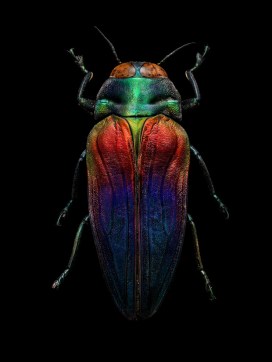
Microsculpture shows insect specimens from the Museum’s collection from a new angle. Photographer Levon Biss took a series of beautifully-lit, high magnification pictures showing striking high-resolution detail. Seeing the insects so close up lets you see colours and patterns that are difficult to see with the naked eye, particularly with very small insects. Seeing this detail makes me realise how beautiful they truly are. What do you think?
Tricolored Jewel Beetle (Belionota sumptuosa), collected by Alfred Russel Wallace in Seram Island, Indonesia. Length: 25 mm Image: Levon Bliss
Here is a video showing how the Microsculpture exhibition came about:





 Crunchy on the outside