A gallery of your favourite insect photos. We’d love to share yours too!
If you would like us to share one of your photos, please email it to hopelearning@oum.ox.ac.uk. If you want us to use your name in the image credit, we will need permission from your parent or guardian.
One of the highlights of the HOPE year is the summer school which gives young people a unique insight into both the fascinating world of insects and the equally-intriguing behind-the-scenes work at the museum.
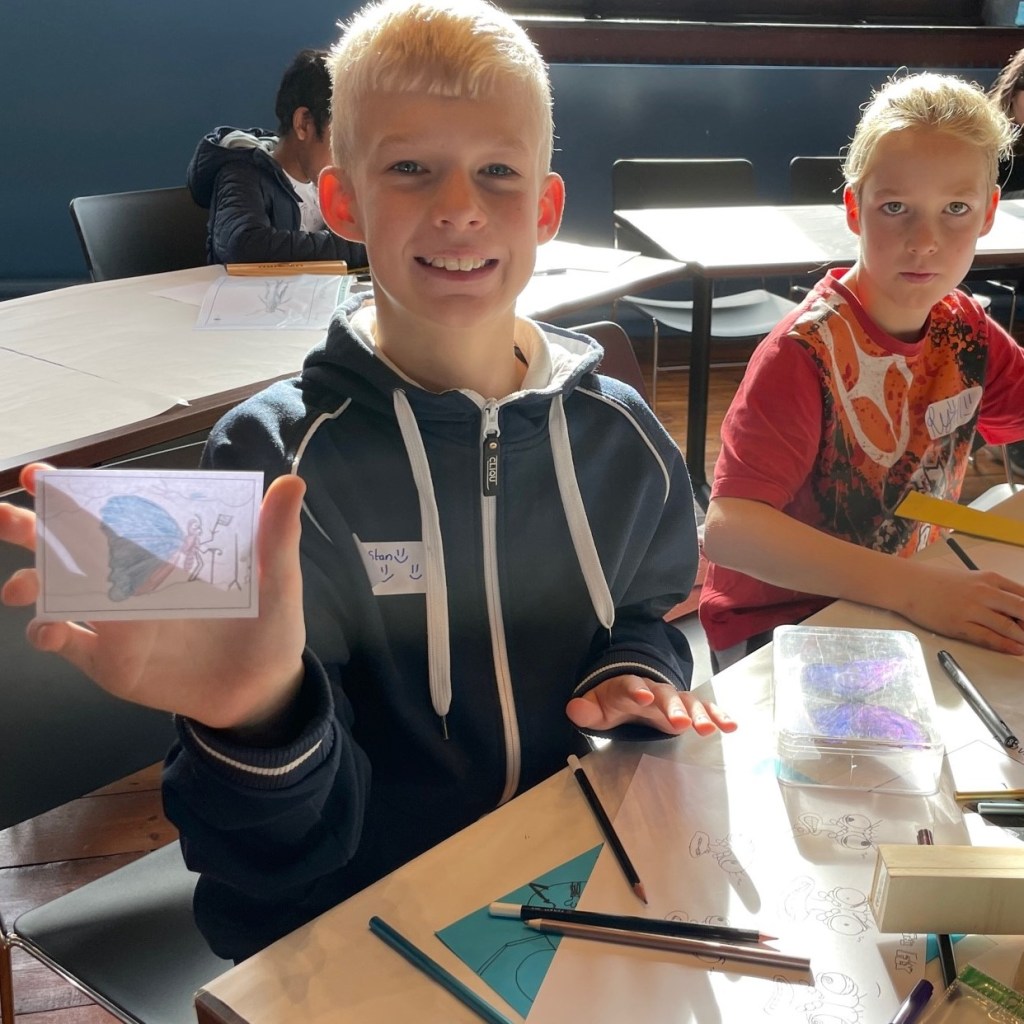
We had to make our summer school virtual in 2020, so we were really pleased to be able to run it at the Museum this year. The wonderful group of enthusiastic young people who joined us spent a week in August exploring the British Insect Collection and the work of entomologists, developing their skills and doing their own research.
Insight into the Museum
Getting to know each other… and the insects!
Insect hunting at the University Parks
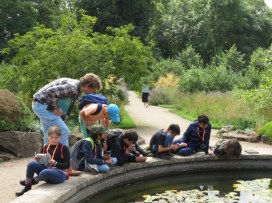
Monday started with an introduction to the world of insects and the ‘Big 5’ British orders, a tour of the entomology department with Collections Manager Dr James Hogan, and some live insect handling. The young entomologists then put their identification skills to the test with some insect hunting with Collections Assistant Louis Lofthouse in the University Parks.
Fantastic Photography
Practising photography skills
Exploring the glasshouses
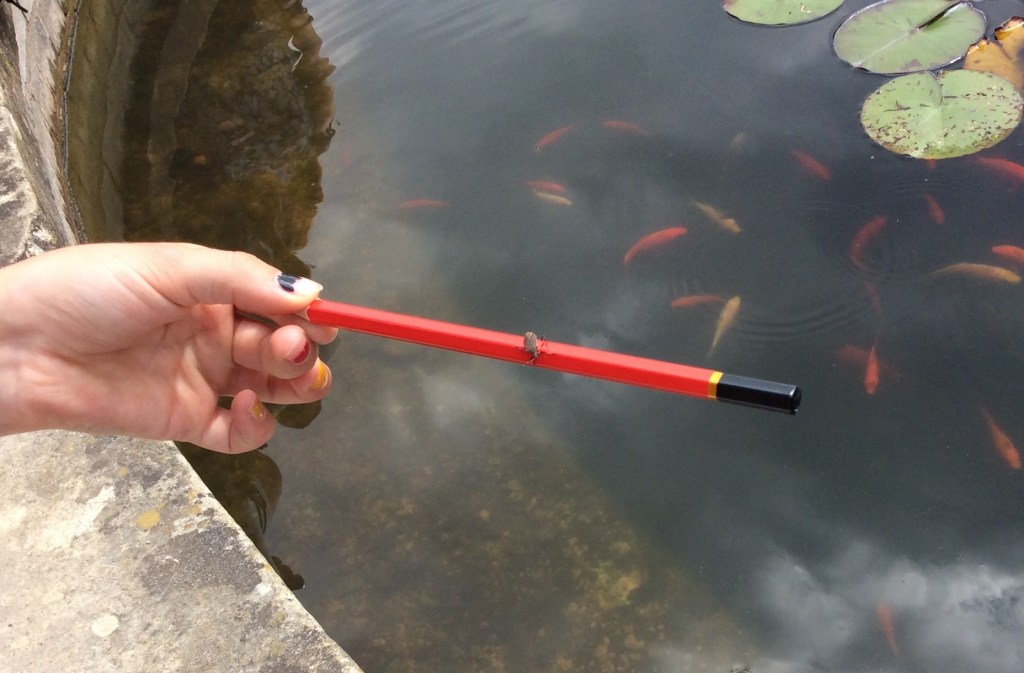
Damselflies (and a little fish whispering) at the pond
On Tuesday we were joined by wildlife photographer Kirk Mason who showed us techniques to develop our insect photography skills at the Botanic Gardens. The fabulous Merton borders and a sunny day meant there was no shortage of subjects! Look out for a future post showcasing the fantastic images the young people took.
Insect Investigations
On Wednesday and Thursday the summer school moved to Harcourt Arboretum where the group learned about practical insect collection techniques with Collections Assistant Ryan Mitchell. They then devised and carried out their own investigations over the two days, joined by Senior Collections Manager Darren Mann on Thursday. We also set up a light trap on Wednesday afternoon, opening it the next morning to reveal the selection of moths that had settled inside, including the Black Arches, Lymantria monacha, pictured above.
Showcase sharing
Pinning beetles for the collection
Explaining investigation results
60,000 grasshoppers in a meadow!
On final day of the summer school, Steven Williams from the HOPE team led the group through pinning preserved insect specimens for themselves. We finished with a celebratory showcase event where our young entomology team shared all that they had done over the week with families and friends.
And there’s more…
Some of our summer school participants were inspired to write their own articles for the blog. Here is Ben’s post, Raising Moths, and we will be publishing more soon. If you’re feeling inspired, why not get in touch using the Contact Us page? Keep an eye on the blog for news of future events at the Museum from the HOPE for the Future Team.
Ben brought in some Poplar Hawk Moths to show the other participants at our recent summer school. Here he describes how he raised them from eggs he received as a gift from his grandfather.
Last year during lockdown my Grandpa gave me 32 hawk moth eggs: 30 eyed and two privet. Not the most common of presents you might think, but these turned into the most enjoyable gift. I was very excited as I tore open the parcel and found the eggs safely packed in a small tube. It took roughly a week for the leafy-green eggs to turn into the most delightful little caterpillars. I decided to call them all Jim. The first thing they went towards was the fresh willow that lay in a small, water-filled jam-jar.
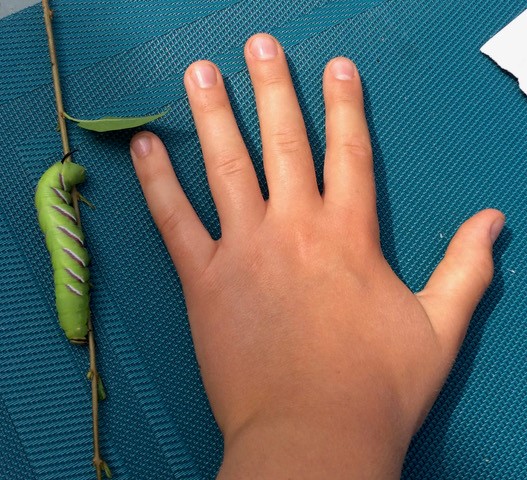
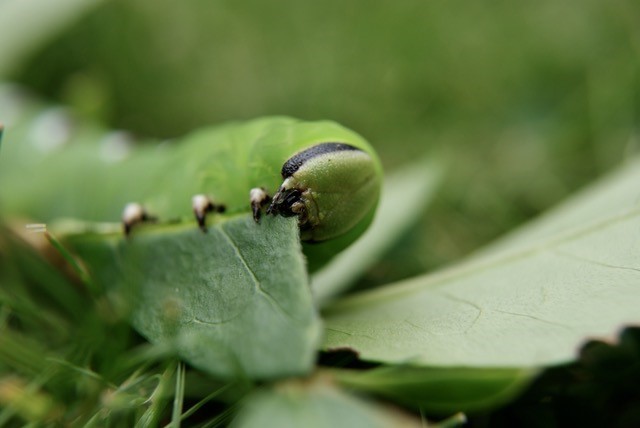
Poplar Hawk moth caterpillar with Ben’s hand for scale. Photo credit: Ben Atwell
Immediately, they started taking chunks the size of their heads out of the leaves until there were no leaves left inside the tank. I was very surprised by how much they ate in proportion to their size. Every day they grew bigger until, within 4 weeks, they were the length of my index finger! They were bright green with white stripes, pink spots and little pointy tails. To help them grow, they shed their skins every few days. Sadly, one little Jim got stuck in his skin whilst shedding and died. Willow-collecting took a lot of effort as it involved daily trips to the canal, but this was a welcome break from staring at my computer all day during online school.
Poplar Hawk Moth larva feeding. Photo credit: Ben Atwell
One morning we found that a lot of the caterpillars were wandering around, banging their heads on the bottom of the tank. They were also turning a darker green which (after a bit of research) we found out meant they needed to bury and become a chrysalis. We put a deep layer of soil into the tank and within minutes they had disappeared. We tucked them up in the shed for winter and waited.
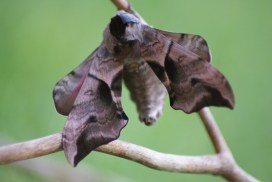
After months of hibernation, they started emerging this spring with crumpled wings, looking very like dead leaves. After stretching out their wings we noticed that we couldn’t see the eyes that the eyed hawk moths are known for, but as we later realised, they only show the eyes as a defence mechanism if they were under attack. Normally it would take a while for the males to seek out the females using their fanned antenna, but because they were in a large tank, it was easy for them to find each other and mate. Within a few days they had laid over 1,000 little green eggs! So, the process of willow collecting began again, but this time, after checking with the county moth recorder, we released the little caterpillars (who this year I called Jeff) into our local wildlife reserve, hoping that they survive and go on to repeat the process in the wild this year.
Poplar hawk Moth adult. Photo credit: Ben Atwell
We are still waiting for the privet chrysalises to hatch, but to keep me busy, my Grandpa sent me 15 poplar hawk moth eggs this spring. These have already been through one cycle of eggs-caterpillars-chrysalis-moth-eggs and I gave some of the eggs to the museum during the Insect Investigators Summer School. I hope the staff have time to collect all that poplar!
The Poplar Hawk Moth, Laothoe populi, is a beautiful insect found thrououghout the UK and is common wherever their foodplants can be found: mainly the poplar trees from which they get their name, aspen and willows. Ben describes the voracious appetite of the larvae well. The adults don’t feed at all and so are short-lived. You can find the adult moth from May to July and the caterpillars from June to October. In Southern England there may be a second generation of adults in the autumn.
Here is the first contribution from one of our readers. It is a tale from Milo Dawes of his exciting hunt for a stag beetle in Richmond Park, London:
On Sunday 20th June I went to Richmond Park. It was a warm day and I had just been in the car for 45 minutes. When I got there, I saw lots of roe deer, but I had come here to find the biggest beetle in the UK – a greater stag beetle. Here is what you need to know to hunt stag beetles:
You should look on and around rotting wood and oak trees, especially where the wood has been chewed away.
Look in spiderwebs for dead lesser stag beetles – the greater stag beetles are strong flyers and can fly out of the webs.
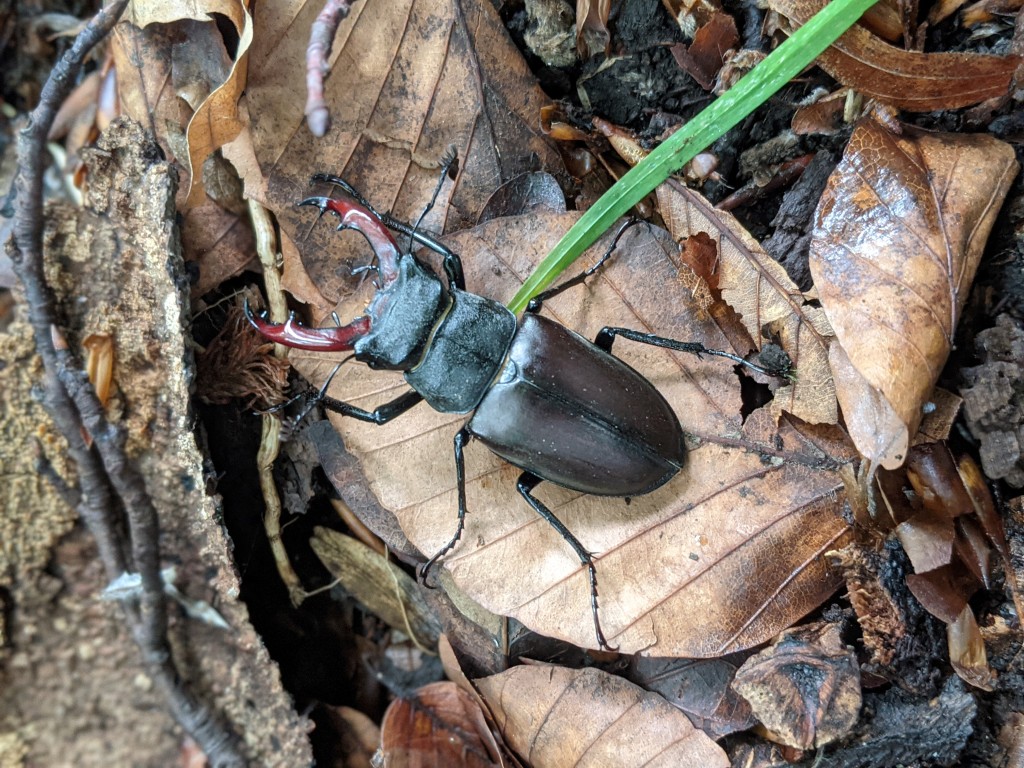
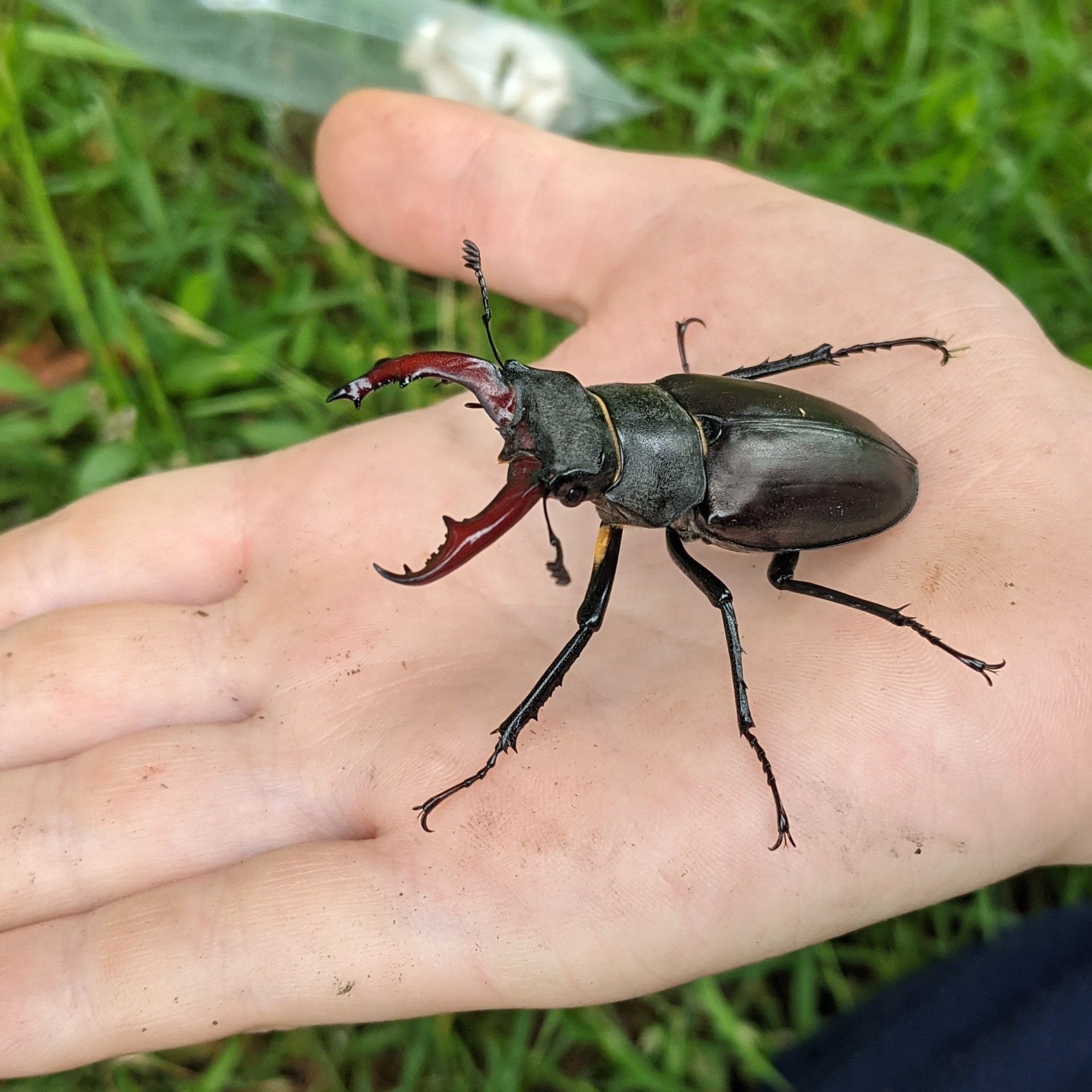
Stag beetle on dead leaves. Image credit: Dawes family.
Next to where I was looking there was a family of grazing deer, chewing away noisily. Slowly and quietly, I walked around some bramble to get to some rotting wood. I lifted it up, but found nothing. Sadly, I walked back, this time the other way around. I spotted something move next to the bramble, out of the corner of my eye. It was a greater stag beetle – the biggest I had ever seen.
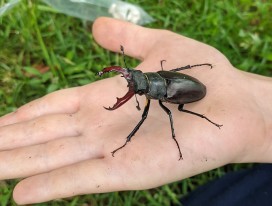
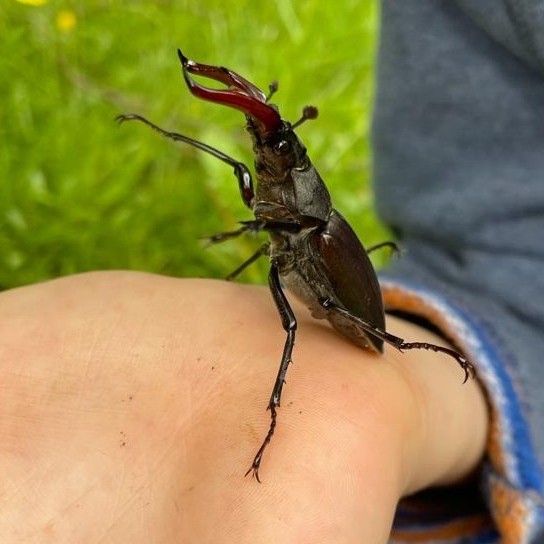
Greater stag beetles are often spotted flying around at dusk, flying with the tip of their jaws facing the sky, like a swordfish jumping out of the water. Males can grow up to 10cm – nearly as big as my hand. Greater stag beetles have a black head and thorax, reddish-brown antlers and a chestnut brown abdomen. They are endangered and rare because humans make life difficult for them. We build on woodland, and rotting wood is often removed from forests. They are being wiped out at an alarming rate. If you spot one, in London, you can help by going to www.wildlondon.org.uk to record your find.
Stag beetle on hand. Image credit: Dawes family
I looked up above me, and there was an ancient oak tree looking very medieval. Then I looked at the stag beetle. It was right next to some rotting wood. I picked it up carefully and ran to a bench. Angrily, the stag beetle waved its antennae at me, and it may have even pointed at me with its claws. The beetle reared up. It was amazing.
Thank you to Milo for this fascinating account. If any of you would also like to write a piece on insects for the blog please contact us or email hopelearning@oum.ox.ac.uk.
Stag beetles are classed as a ‘priority species’, and are protected under the Wildlife and Countryside Act 1981. It is therefore important that you do not remove any from where they are found.
Professor Karim Vahed tells us about how he first became interested in insects and his work with Bush Crickets at the University of Derby. He explains what makes them so fascinating and why the Southern European Bush Cricket, Gryllus bimaculatus, is his favourite insect.
Professor Karim Vahed on why Bush Crickets are his favourite insect.
Do you have a favourite insect? What is it about it that you like? You can let us know using our Contact Us page.
If you enjoyed this video, you might like to take a look at others featuring scientists and other people who work with insects on our ‘People‘ pages.
During the summer you may notice large beetles flying around in gardens and other green spaces. These insects are called ‘chafers’. While they may look similar, there are in fact several different species all known by this common name.
The name chafer comes from the Old English word for beetle, ceafor. It is similar to the modern German word for beetle, käfer. So, ‘chafer’ really just means ‘beetle’ but in English it came to be used for beetles that were particularly noticeable. Chafers got themselves noticed because they are large, the adults can fly and often emerge in large numbers at the same time of year, sometimes making a buzzing noise as they fly. They are attracted to lights, so often fly in open windows, then bump around the room trying to get out. Farmers and gardeners often think of them as pests because they can damage plants.
Chafers all have a similar life cycle. The larvae live in the soil or dead wood, often for several years. They are sometimes thought of as pests because they may feed on the roots and other parts of plants, but they are important recyclers, feeding on dead, decaying material and helping to return the nutrients it contains back into the soil. The larvae then pupate and survive the cold winter months in this form. The adults emerge in late spring, or summer, depending on the species. It may seem that large numbers of beetles have suddenly appeared out of nowhere, but in fact these adults have just emerged at the same time. The adult beetles mate and lay eggs which will become the next generation of larvae.
Cockchafer, Melolontha melolonta
The largest of the British chafers is the cockchafer (Melolontha melolontha). The adults emerge in late April or May, giving it another common name, the ‘Maybug’. They fly in a wobbly way and make a buzzing noise. This can make them seem a bit alarming but they are completely harmless to humans.
Cockchafers were once a huge agricultural pest and could emerge in such numbers that people were encouraged to eat them! A French recipe for cockchafer soup was published in the 1800s (https://en.wikipedia.org/wiki/Cockchafer_soup) and in the 1920s, German children were reportedly eating sugar coated cockchafers.
Pesticides brought this marvellous beetle to the brink of extinction in the UK during the last century. Now changes in agriculture and pesticide use mean that cockchafers are making a comeback and they can be found across England, although they still rarer in Scotland. The nationally much rarer Northern Cockchafer (Melolontha hippocastani) is found in Scotland, Northern England and Ireland.
The Summer Chafer (Amphimallon soltitiatis) looks a bit like the cockchafer, but is smaller, at about 20mm, and had a rounded, rather than pointed tail end . Traditionally, this beetle is associated with the Summer Solstice, or longest day of the year, because the adults often emerge in the second half of June. In fact, the Summer Chafer can be found all over Britain in June and July. Kate and Susie found lots of Summer Chafers on a visit to Orchard Meadow Primary School in Oxford on 23 June this year and have seen it in the grounds of several other schools we have visited.
Another similar beetle is the Welsh Chafer Hoplia philanthus which, despite its name, is not restricted to Wales, but also found in Southern England and the Midlands. It is smaller and less ‘hairy’ than the other chafers and can be recognised by the single large ‘claws’ on the end of its legs.
Welsh Chafer, Hoplia philanthus. Image Credit: Neil Stanworth
Eleanor and her father kindly sent us this picture of a Welsh Chafer they caught in their garden in the Midlands recently using a pitfall trap they made after watching Kate’s video from a few weeks ago. We’d love to see pictures of beetles and other insects you have found.
Some chafers are a striking green colour. One of these is the Rose Chafer (Cetonia aurata) which flies between May and October. Gardeners may consider it as a pest, particularly if they grow roses, because the beetles feed on their plants but, like the other chafers, these beetles are also important recyclers.
Another green chafer is the Noble Chafer (Gnorimus nobilis). You can tell the two apart because the Rose Chafer has smooth wing cases but the Noble Chafer has wrinkled ones and is metallic green with white speckles. While adult Noble Chafers feed on plants like hogweed, the larvae live in the decaying wood of old fruit trees. Because of this, the Noble Chafer is found in traditional orchards. As these have disappeared, so has this beautiful beetle which is now rare and a priority species under the UK biodiversity framework.
So, look out for chafers this summer and send us pictures of the ones you find. You may even come across one that’s quite rare!































 Crunchy on the outside