Bee-flies: A sign of Spring

At this time of year, after the long winter months, we are all looking for signs of Spring.   One thing that entomologists look forward to is the first sightings of bee-flies.   These very cute, furry flies start to emerge in late February and early March.

Bombylius major, the dark-edged bee-fly, is one of Erica McAlister’s favourite British insects and she tells us why in this video.

Find out more about Bee-flies

To find out more about bee-flies, check out this page on the Dipterists Forum. There is also an excellent guide to bee-fly identification which you can find here.

In addition, the Dipterists Forum run an annual Bee-fly Watch which gathers together records of sightings.  This is really important for monitoring changes in distribution and flight period.  You can contribute to this important science project by adding your sightings here:

Bee-fly Watch | Soldierflies and Allies Recording Scheme (brc.ac.uk)

Have you seen any bee-flies yet this Spring? Let us know, too, by telling us below or by using the Contact Us page.

Insect Fun in the Museum – Saturday 12th March

Super Science Saturday: Fantastic Minibeasts

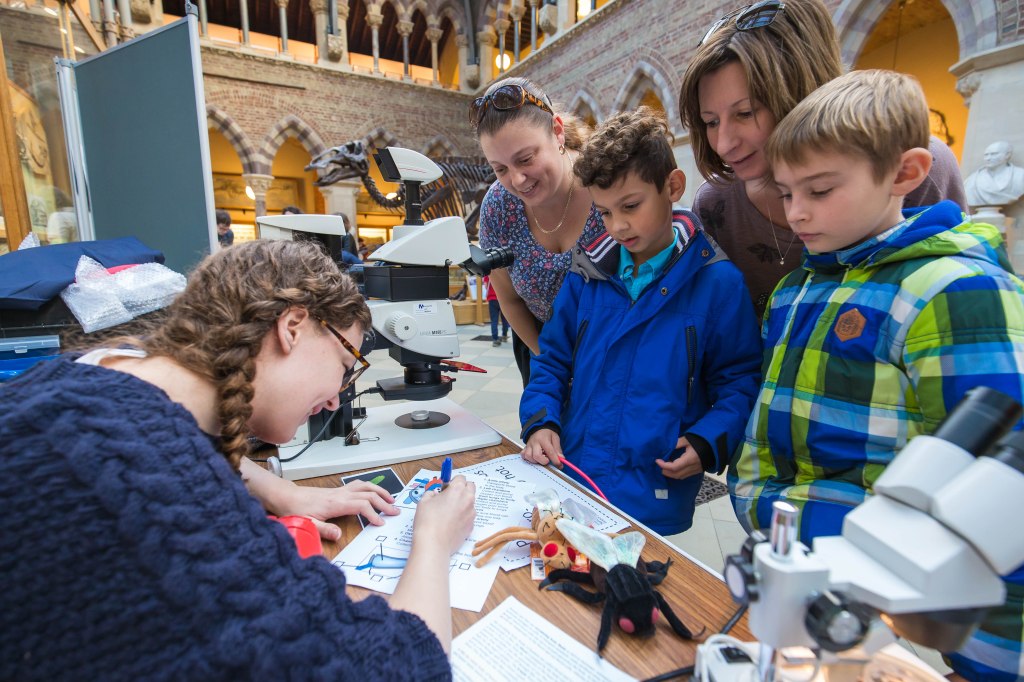
OUMNH Super Science Saturday by IWPhotographic

Drop in to the museum for this fun family Science Fair on Saturday 12th March, 12-4pm. Meet experts to find out more about tiny creatures like insects, spiders and more!

No need to book – just come along and, whilst you are in the museum, why not join us for our Insect Show: Insects: Beasties or Besties.

Insects: Beasties or Besties Family Science Show

Saturday 12th March, 1pm and 2.30pm

Ages 6+

Come along to our fun and interactive family show all about insects. You’ll meet a visitor to the museum, with a dislike of insects, who is confronted by a giant talking dung beetle! The unlikely pair take a journey, looking at the wonderful, and vitally important, role of insects in our world.

Please note that the show will be held in the Museum’s Lecture Theatre which has a capacity of 195 seats and social distancing will not be in place. Visitors are encouraged to wear a face mask for the duration of the show and hand sanitiser will be available when you enter/exit. 

The show is FREE but please book online.

Red-Tailed Bumblebee

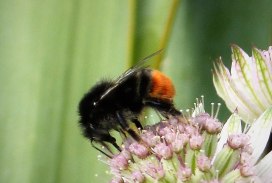
If you see a big jet-black bumblebee with a red tail in Britain, its probably the Red-tailed Bumblebee, Bombus lapidarius. If it has a scruffy white collar, then its a male.

The Red-tailed Bubmblebee has extended its range northwards in recent years and is now common throughout Britain. It can often be seen in parks and gardens. The workers have short tongues and forage on flowers like daisies and thistles which have a big area for them to land on and are made up of small florets, each with a little nectar. Leaving dandelions to grow in the spring helps provide food for these and other insects early on in the growing season.

Let dandelions grow in spring to help insects. Image credit: Pixabay / Claudiu Mladin CC0

The Queens nest under stones and so are sometimes disturbed when these are moved. If you find one like this, have a look without disturbing it then just put the stone back. They may also enter our homes through open windows in search of nesting sites.

The Red-shanked carder bee, Bombus ruderarius, can look similar but is much scarcer in the UK. While the Queens of B. ruderarius are smaller. the workers of the two species can be a similar size. You can tell the difference by looking at the back legs. B ruderarius has red pollen baskets on its otherwise black legs, whereas the leg hairs of B. lapidarius are all black.

Lincoln Kwong was one of the participants at our Summer school in August. He was so inspired by the HOPE collections team at the museum that he decided to start his own insect collection. One of his first specimens was a dead red-tailed bumblebee that he found in his garden. He preserved and pinned this and recorded the data following advice from James.

Bombus lapidarius. Image credit: Lincoln Kwong

Let us know if you have your own collection. You can get in touch using the CONTACT US page. We’d also love to see any pictures any would be happy to feature them in our PHOTO GALLERY!

Featured image credit: Gail Hampshire CC BY 2.0

Events 4U in ’22!

Happy New Year!  We hope 2022 is full of exciting times and awesome insect discoveries. We are SO excited because this year, we are inviting you to join us for FREE Crunchy on the Outside events here at the museum. Come and take part in some fabulous activities specially designed for young people, aged 10 – 14, interested in natural history and insects in particular. Keep an eye on this blog for news of forthcoming events.

Read on to find out more about the first event happening in February half term and how to book!

Acorn Weevil – Curculio glandium

Insects under the Lens – Wednesday 23rd February 2022, 1 – 3pm

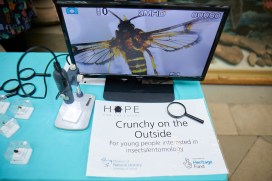
Intrigued by insects? Join us to take a closer look at some of the museum’s 5 million insect specimens under a variety of different lenses. We will be using microscopes and digital photography to reveal beautiful details of insect anatomy not visible to the naked eye.  This workshop promises to unlock some of the secrets of the insect world and develop your powers of observation!

Six-belted Clearwing Moth under the microscope

FREE workshop – Insects under the Lens 

Wednesday 23rd February 2022 , 1pm to 3pm

Museum of Natural History, Parks Road, Oxford, OX1 3PW

10 to 14 year olds

To book – email: hopelearning@oum.ox.ac.uk

Christmas Quiz Answers

We hope you enjoyed our Crunchy Christmas Quiz! Here are the answers.

  1. The holly and the ivy mining bee
  2. Adventomologists
  3. The Grinchafer
  4. The most wonderful time of the yearwig
  5. Snowmantis / Snowmantid
  6. Bethlehemiptera
  7. Myrrhino beetle
  8. 25 December moth
  9. Angelytra
  10. Yulepidoptera

Have fun over the holidays and have a Happy New Year!

Christmas Quiz 2021

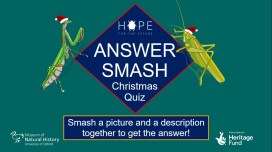
To round off an eventful year here at Crunchy on the Outside, we have put together a quiz for you combining our two favourite things: Insects and Christmas!

There are ten questions in the video. Each of the answers is formed by smashing together the two clues. One clue is about insects, the other about Christmas. We’ve included a couple of examples at the start to help you get the hang of it. Don’t worry if a question seems tricky, it’s just for fun and we’ve included some clues below.

Clues

  1. The scientific name of this insect is Colletes hederae.
  2. You will find out about what these scientists study here: https://crunchyontheoutside.com/category/people/
  3. We wrote about these insects in the summer: https://crunchyontheoutside.com/2021/07/05/chafers/
  4. Complete title of the song: Clue: “It’s the most wonderful….”.
  5. This insect may seem holy, but it’s looking for prey.
  6. Find out the name of this group of insects here: https://oumnh.ox.ac.uk/files/2insectidpdf-0
  7. This beetle is named after another horned animal.
  8. We wrote about this insect recently: https://crunchyontheoutside.com/2021/11/29/the-delightful-december-moth/
  9. You’ll need to know the scientific name for the wingcases/hardened forewings of a beetle.
  10. Find the name of this group of insects here: https://oumnh.ox.ac.uk/files/2insectidpdf-0

Answers

Good luck! We’ll publish the answers on the blog on Christmas Eve, so keep an eye out for them. Let us know how many you got right!

Best wishes for Christmas and the new year from all of us at the Crunchy blog!

Kate, Rodger & Susie