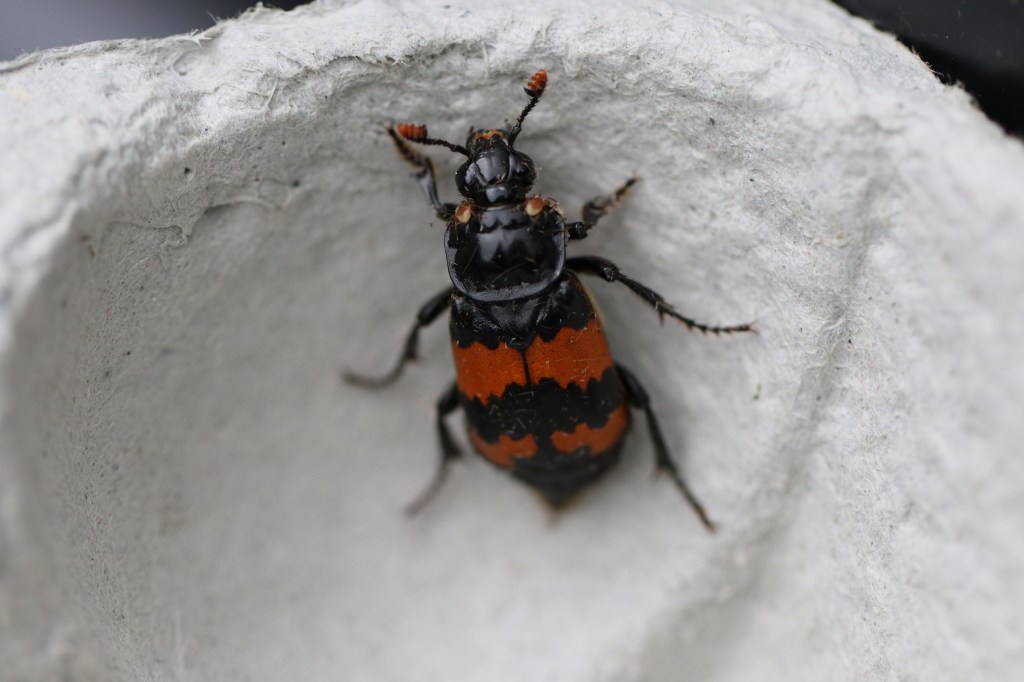
Carrion beetles are a family of beetles, Silphidae, that feed on decaying organic matter, such as dead animals. This makes them important natural recyclers.
They are also Ashleigh Whiffin’s favourite group of insects. She tells us a bit about them in this video:
Ashleigh Whiffin, Assistant Curator of Entomology for National Museums Scotland, telling us about her favourite group of insects.
Do you know of any other insects that act as decomposers and natural recyclers? Tell us about them in the comments below or in the Contact us section of the blog.
To round off an eventful year here at Crunchy on the Outside, we have put together a quiz for you combining our two favourite things: Insects and Christmas!
There are ten questions in the video. Each of the answers is formed by smashing together the two clues. One clue is about insects, the other about Christmas. We’ve included a couple of examples at the start to help you get the hang of it. Don’t worry if a question seems tricky, it’s just for fun and we’ve included some clues below.
Clues
The scientific name of this insect is Colletes hederae.
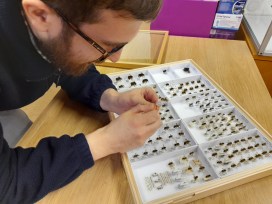
Louis is a Collections Assistant, for the HOPE for the Future Project, at Oxford University’s Museum of Natural History. Here he is telling us about his role and how he first became interested in insects.
Louis mentions that through his job he gets to see rare and extinct insects that you normally might not get the chance to see. Can you tell us about any rare or extinct insects that you know about? Let us know in the comments below, or through the contact us page.
Insects that have been trapped in amber (fossilised plant resin) can be preserved in amazing, stunning and beautiful detail. This short video shows you how to make a fossilised insect themed decoration that can be hung on your Christmas tree for the festive period, or can be displayed around you home all year round.
I have included the written instructions in case you find them helpful.
You will need:
A glue stick
Scissors
A Pencil
Card (e.g. cereal box)
Paper String/wool
Orange cellophane sweet wrapper(s)
Coloured pencils/pens/glitter
Instructions
Take two pieces of card that are roughly the same size. Put them together with the plain sides facing out.
On one side draw a frame, at least 1cm thick. It can be any shape you choose.
Carefully cut out the frame, including the middle.
Check that your cellophane wrapper will cover both frames. If not, use two.
Use the glue stick to attached the cellophane to the patterned side of the frames.
Trim the cellophane around the frames.
Take a small piece of paper that will fit inside the frames and draw an insect on one side. Trim the excess paper around the insect and then draw a similar insect on the other side.
Use the glue stick to attach the frames together with the insect in the middle, and with the wool/string forming a loop that you can use to hang your decoration.
Decorate your frame using coloured pencils, pens, glitter or anything else that you choose.
We would love to see your amber decorations. Also, can any of you spot the key feature of an insect that I forgot to draw to my insect picture in the video? Let us know in the comments, or by the Contact us page.
To find out more about Insects in Amber look out for a post early next year.
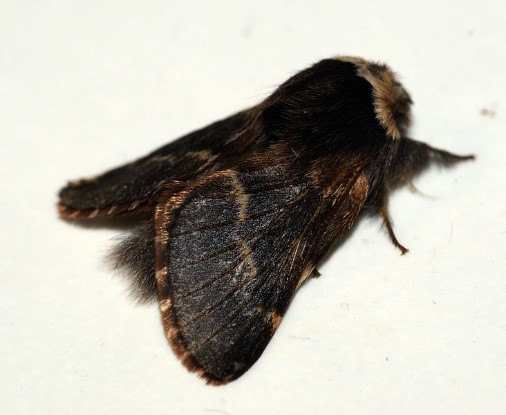
The December Moth, Poecilocampa populi, is found all over the UK. Because it is more resistant to cold than most other moths, the adults are common in parks, gardens and woodland during late autumn and winter.
Marvellous Moths
Many people don’t give moths a lot of thought. Most have incredible camouflage and they often fly at night, so we don’t tend to see them. When we do think of moths, it may be just as a kind of drab butterfly that sometimes eats our clothes. In reality, there is much more to the world of moths than we might think, and they are very important to our world.
Moths, together with butterflies, belong to the group of insects called the Lepidoptera (“scaly wings”) There are over 2,500 species of moth in the UK and only a very few will eat our clothes. Many of these moths are beautiful, either because of their spectacular colouration or because of the way their camouflage enables them to blend into their habitat.
Moths are important in ecosystems. Both adult moths and their caterpillars play crucial roles in food chains, feeding on plants and being eaten by bats, birds and other animals. It is estimated that about 35 million caterpillars are eaten by blue tit chicks every year! Moths also play a vital part in the reproduction of several plant species because of their role as pollinators.
‘Like a moth to a flame’
Adult December moths are night-flying and, like other moths, they are attracted to light at night. Entomologists are still not sure exactly why this is. One theory is that moths use the moon to navigate and can mistake a light for the moon. Another is that they normally fly with the lighter sky above them and a light source near the ground confuses them into flying downwards. This would explain why they are attracted to street lights and lit windows, and also why they fly downwards into light traps.
December moth, Poecilocampa populi. Photo: Ben Sale CC-BY 2.0
Life Cycle of the December Moth
Larvae and pupae of the December Moth in the HOPE Collection at the Museum
While adult December Moths can be found throughout autumn and winter, each individual is short-lived and does not feed. They mate and the females lay their eggs on food plants. The eggs overwinter and the larvae only emerge the following spring. These caterpillars can be found throughout spring and summer taking advantage of the new growth of leaves. They are active voracious feeders at this time and will eat the leaves of a wide range of deciduous trees. When they have gained enough weight, they pupate, with the adult moths emerging to repeat the cycle in late summer and autumn.
Moths are important indicator species: their presence tells us about the overall health of the environment. Unfortunately, what moth populations seem to be telling us is that something is wrong.
Comparing the number and type of moths found in Britain today with those recorded in historic insect collections like the HOPE Collection at the Oxford University Museum of Natural History, shows us that moths have declined by about 40% in southern Britain. Over 60 moth species have become extinct in the UK over the last century and many more are at risk of disappearing forever.
Other animal species which rely on moths as food are also suffering, including a decline in bats flying over farmland and reduced numbers of cuckoos, which specialise in feeding on hairy moth caterpillars which other birds tend to avoid.
We need to do more research to fully understand exactly why moth species are declining in Britain, but it is likely to be because of a combination of factors including loss of habitat, farming practices such as clearing hedgerows and the use of pesticides, and climate change.
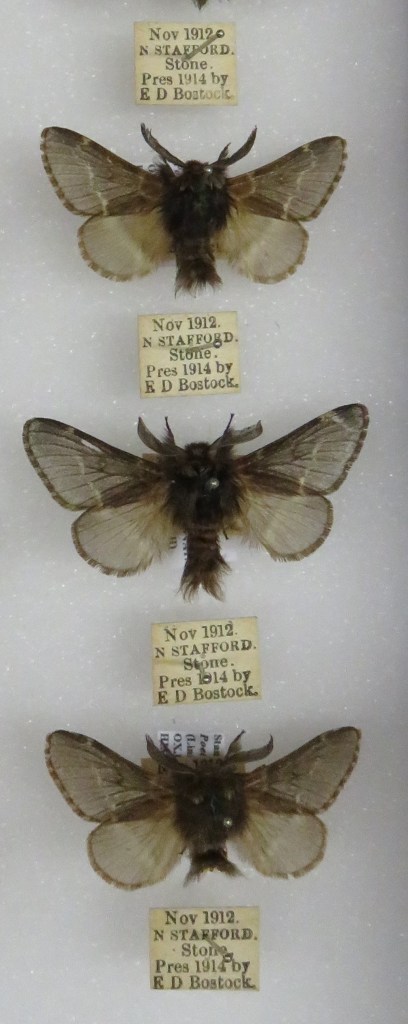
Adult December moths in the HOPE Collection
Ways we can help moths
Fortunately, many moth species under threat are found in parks and gardens, so we can all do things to help:
Not over-tidying gardens; a more natural look is much better for insects.
Growing a wide variety of large and small flowering plants and, if you have room, shrubs and trees.
Avoiding the use of weed killers and insecticides.
Reducing light pollution from outdoor lights
Reducing your carbon footprint, for example, by driving less and walking or cycling more.
If you enjoyed reading about the December Moth, you might like this post by Ben on Raising Poplar Hawk Moths.





 Crunchy on the outside