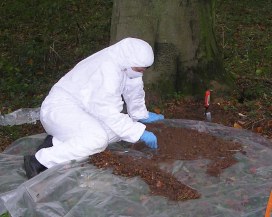
How can insects help solve crimes? In this video, forensic entomologist Dr Amoret Whitaker discusses her work and how she came to work with some common flies that can provide important clues.
The blow flies that Dr Whitaker talks about are a family of flies (Diptera) called the Calliphoridae. They often have bodies with a metallic sheen and are also known as carrion flies, bluebottles and greenbottles. The fly pictured in the video is Cynomya mortuorum, known as the yellow-faced fly or sometimes, more gruesomely, as ‘the fly of the dead’.
Forensic entomology is just one way in which scientists work with insects. If you would like to know more about different entomologists and what they do, visit the People section of the blog.
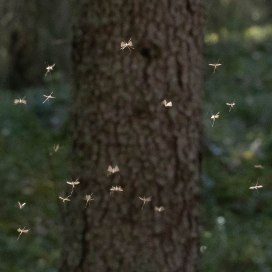
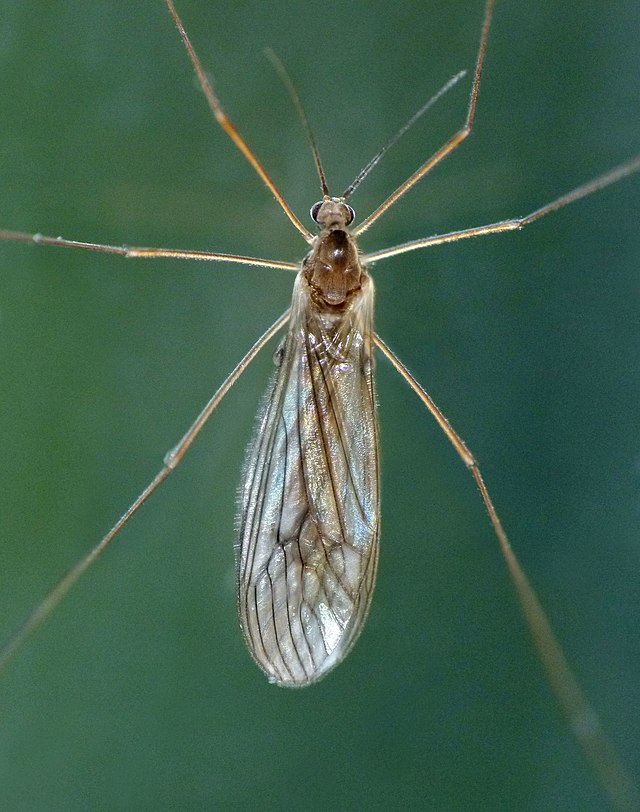
There aren’t many insects out and about at this time of year but on a warmer day you may see clouds of winter gnats (Trichocera annulata and related species) ‘dancing’ in the sunlight.
What persuades these small flies to come out in the depths of winter? Well, the dancers are males hoping to attract females. It’s thought that gathering together in a group like this makes it easier for the females to spot them. The trouble is, each individual male then has to compete for her attention!
If you are out for a walk, it may seem that a group of gnats is following you around; that’s because they are! If you are the warmest thing around, they will stay near you and make the most of your body heat.
You don’t need to worry about being bitten: although these gnats look a bit like mosquitos, they are completely harmless. The adults aren’t interested in drinking your blood, they feed on nectar. The larvae can be found in leaf litter, feeding on fungi, leaf mould and other decaying matter.
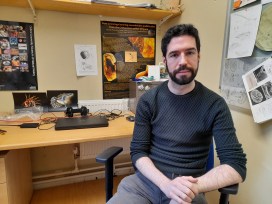
Ricardo Pérez-de la Fuente, Deputy Head of Research here at the Oxford University Museum of Natural History, tells us how he first became interested in natural history. Hear about his work as a palaeoentomologist specialising in the study of insects fossilised in amber, including the discovery of a fascinating lacewing species from around 100 million years ago with an ingenious method of camouflage and defence.
Ricardo’s research into the fossilised lacewing species, Hallucinochrysa diogenesi, has shown that the strategy of covering the body with materials from the environment as a way to camouflage and defend, known as trash-carrying, evolved at least 100 million years ago. Several species of invertebrates use this strategy today, including green lacewing larvae, and some sea urchin and crab species. Can you think of other ways in which insects defend themselves from their prey? Let us know in the comments below or in the Contact Us section of the blog.
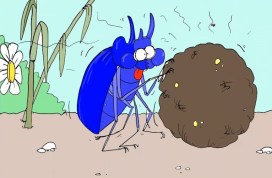
Previously, Chris Jarvis showed us how to draw a mighty Minotaur Beetle (Typhaeus typhoeus) complete with its own ball of dung! In this video Chris returns to add some finishing touches to this picture. He shows us how to convey the size of the beetle, and how to use colour to great effect.
We’d love to see any pictures you draw of insects, whether it is an ant, bee, caterpillar or your very own Minotaur beetle. Share with us at hopelearning@oum.ox.ac.uk.
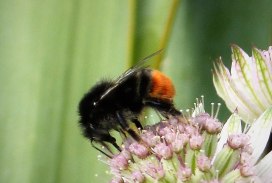
If you see a big jet-black bumblebee with a red tail in Britain, its probably the Red-tailed Bumblebee, Bombuslapidarius. If it has a scruffy white collar, then its a male.
The Red-tailed Bubmblebee has extended its range northwards in recent years and is now common throughout Britain. It can often be seen in parks and gardens. The workers have short tongues and forage on flowers like daisies and thistles which have a big area for them to land on and are made up of small florets, each with a little nectar. Leaving dandelions to grow in the spring helps provide food for these and other insects early on in the growing season.
Let dandelions grow in spring to help insects. Image credit: Pixabay / Claudiu Mladin CC0
The Queens nest under stones and so are sometimes disturbed when these are moved. If you find one like this, have a look without disturbing it then just put the stone back. They may also enter our homes through open windows in search of nesting sites.
The Red-shanked carder bee, Bombus ruderarius, can look similar but is much scarcer in the UK. While the Queens of B. ruderarius are smaller. the workers of the two species can be a similar size. You can tell the difference by looking at the back legs. B ruderarius has red pollen baskets on its otherwise black legs, whereas the leg hairs of B. lapidarius are all black.
Lincoln Kwong was one of the participants at our Summer school in August. He was so inspired by the HOPE collections team at the museum that he decided to start his own insect collection. One of his first specimens was a dead red-tailed bumblebee that he found in his garden. He preserved and pinned this and recorded the data following advice from James.
Bombus lapidarius. Image credit: Lincoln Kwong
Let us know if you have your own collection. You can get in touch using the CONTACT US page. We’d also love to see any pictures any would be happy to feature them in our PHOTO GALLERY!
Happy New Year! We hope 2022 is full of exciting times and awesome insect discoveries. We are SO excited because this year, we are inviting you to join us for FREE Crunchy on the Outside events here at the museum. Come and take part in some fabulous activities specially designed for young people, aged 10 – 14, interested in natural history and insects in particular. Keep an eye on this blog for news of forthcoming events.
Read on to find out more about the first event happening in February half term and how to book!
Acorn Weevil – Curculio glandium
Insects under the Lens – Wednesday 23rd February 2022, 1 – 3pm
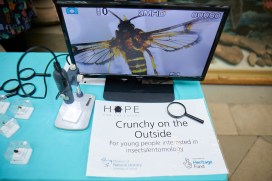
Intrigued by insects? Join us to take a closer look at some of the museum’s 5 million insect specimens under a variety of different lenses. We will be using microscopes and digital photography to reveal beautiful details of insect anatomy not visible to the naked eye. This workshop promises to unlock some of the secrets of the insect world and develop your powers of observation!
Six-belted Clearwing Moth under the microscope
FREE workshop – Insects under the Lens
Wednesday 23rd February 2022 , 1pm to 3pm
Museum of Natural History, Parks Road, Oxford, OX1 3PW








 Crunchy on the outside