Make a pitfall trap

Try out a new technique for finding insects with HOPE Learning Officer, Kate.

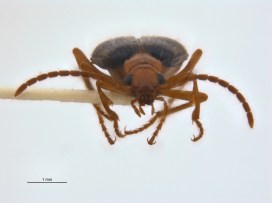
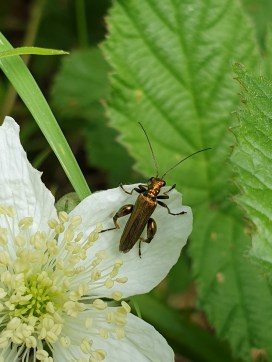
Have you found any interesting insects lately?  Along with the other HOPE Learning Officers, I have been out and about in Oxfordshire schools where we have found some fantastic insects.  Among my recent favourites is the thick-legged flower beetle, Oedemera nobilis

These beautiful beetles are distinctive with their stunning emerald-green colour and their chunky thighs which are seen only in the males.   We have also found lots of varied species of ladybird including cream spot, 14-spot and eyed ladybirds. Generally, we collect insects using sweep nets and beating trays but, of course, you might be lucky enough to find some interesting insects just by looking in the right places.  Under stones, logs, leaves, in amongst long grass or on flowers are all excellent places to start.  Insects, however, are very good at hiding so why not make a pitfall trap? This can be a great way to find a range of insects, particularly ground beetles.

Here are the written instructions.

You will need: 

  • A small pot such as a clean yoghurt pot
  • A trowel for digging
  • A few stones
  • A small piece of wood or a flat stone to act as a rain cover

What to do:

  1. Find a good spot for your trap on level ground, amongst vegetation.
  2. Dig a hole big enough to sink your pot so that it is completely level with the ground.
  3. Place the pot into the hole. You can put a few leaves, small stones and twigs in the pot to make any insects you catch feel at home.
  4. Build a cover over the trap by placing stones around the pot and resting a flat stone or piece of wood on top.  Make sure there is enough space for insects to crawl under.  This will stop the pot filling with water if it rains.
  5. Wait for a few hours or, better still, overnight.
  6. When you are ready, empty your pot carefully into a tray so you can see what has fallen in.  Take photos so that you can have a go at identifying what you have caught.
  7. Remember to check your pitfall trap every day and return any creatures carefully to a sheltered spot in vegetation.

We would love to know what you find! Let us know by commenting below or by using the Contact Us page.  Happy insect collecting!

Insect investigators Summer School

This post was first written in June 2021. The summer school is now full and booking has closed. You can find lots of insect activities on the Museum of Natural History webpages for our 2020 virtual Six Legs of Summer summer school.

We are very excited to announce that we will be running an Insect Investigators summer school at the Museum of Natural History during the week 2 – 6 August 2021.

If you are aged between 10 and 14, discover the amazing world of beetles, bees and butterflies at our free Insect Investigators Summer school, 10am to 3pm on 2nd6th August 2021.

The summer school will be for 10-14 year olds and is free of charge, thanks to generous funding from the National Lottery Heritage Fund. Those taking part will gain a behind the scenes insight into the British Insect Collection and the work of museum, photograph insects at the Botanic Gardens with a wildlife photographer, learn how entomologists collect and study insects with practical sessions at Harcourt Arboretum, and carry out their own insect investigation. Perhaps you’ll even have an insect added to the collection!

Past summer school participants have added to the British Insect Collection

If you would like to know more, or want to book a place, please get in touch using the Contact Us page, or email Rodger, Susie and Kate at hopelearning@oum.ox.ac.uk. We’re looking forward to hearing from you!

Why collect insects

As part of the HOPE project, Kate, Rodger and I take insect specimens from the collection out to schools. Two questions I have been asked a number of times are:

  1. Are they real?
  2. Why did you kill them?

The answer to the first question is fairly simple. Yes! They are real insects that were once alive, but are now dead and have been carefully preserved.
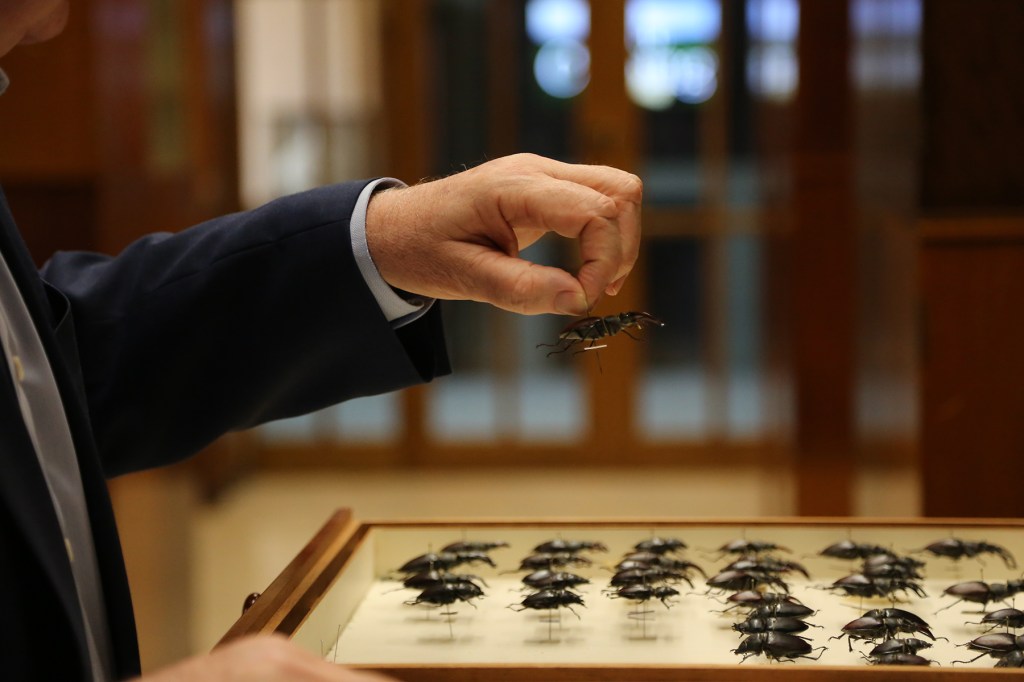
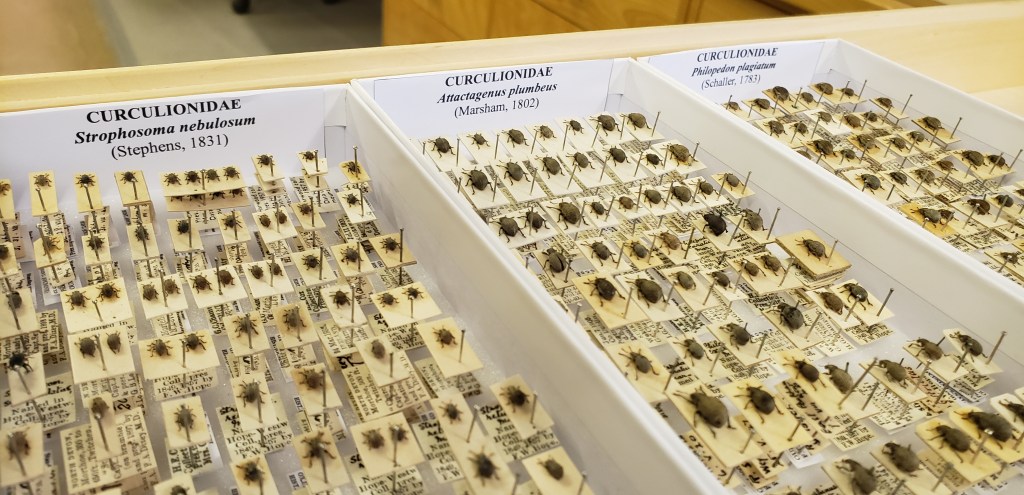
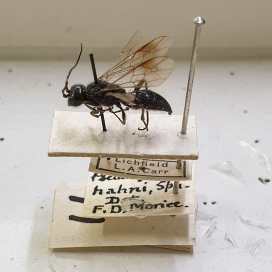
The answer to the second question is a little more complicated. The British Insect Collection, at Oxford University Museum of Natural History, consists of over 1 million specimens, collected over a period of about 200 years. I think the real questions are why do we keep this vast assortment of insects and what are they used for?

Identification

When investigating insects, it often is not possible to identify them out in the field, or from photographs. Some insects need to be looked at under a microscope, or even dissected, to tell them apart and identify them to species level. Also, just think how small some insects are, it could be very easy to miss them altogether. As a result, entomologists sometimes use insect collecting methods that involve killing the insects, and taking them back to their labs for identification.

The collection is also used to help with identification. If an entomologist comes across an insect species they have not seen before, or are struggling to identify, they can compare it with those already in the collection. Getting a correct identification is really important. It helps entomologists know if they are talking about the same insect.

Historical record

In the collection each specimen has a label which gives key information regarding where, when and by whom it was found. The collection contains specimens for almost the entire history of British entomology, giving us information on the biodiversity of Britain, during this time. From this we can see how insect populations have changed, for example how the numbers of the different forms of the Peppered moth (Biston betularia) varied during and after the Industrial Revolution. Scientists from all over the world regularly use and reference the British Insect Collection as part of their research.

The collection offers an amazing glimpse into the natural world with dozens of iconic species now considered extinct in the UK, including the large copper butterfly and the blue stag beetle. It also contains many examples of the first British capture of insect species.

Education

We use the collection to help people to learn about the wonders and importance of insects in our world. While it is very valuable for people to see living insects in their natural environment, they often move around very fast. It is much easier to use specimens from the collection to look at and understand the features of different insects.

In my experience of taking specimens into schools, seeing these insects up close in this way not only inspires a sense of wonder, interest and excitement, but also allows those who are more nervous of these little critters to gain confidence as well as understanding.

PEOPLE: ERICA MCALISTER

Meet Erica McAlister, Senior Curator of Flies and Fleas (Diptera and Siphonaptera) at the Natural History Museum in London. In this video, Erica tells us about her work and how she became interested in insects.

Let us know what inspired your interest in insects by adding a comment below.

Cartooning with Chris

Here at Crunchy on the Outside we love insects and we also love cartoons. What could be better, then, than cartoon insects?!

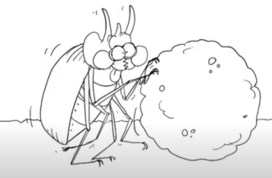
In this video Chris Jarvis shows us how to draw a mighty dung beetle called the Minotaur Beetle (Typhaeus typhoeus) complete with its own ball of dung!

Minotaur beetles grow to about 2cm in length and can be seen between September and July. They live in grassland and heathland with sandy soils. They feed on rabbit droppings and other dung (yum!) which they roll into balls and bury them in nests which can be over a metre deep underground. Male beetles may defend these nests using their long horns. The females lay their eggs in these nests. The eggs then hatch and the larvae feed on the tasty dung!

Watch the video carefully and you will see that Chris has included many of the key features of this fascinating beetle. He has deliberately left one insect feature out of his drawing. Can you spot what is missing? Here’s a clue: they help insects sense their environment.

Let us know what you think is missing by commenting below, or sending us a message using the Contact Us page. We’d also love to see you own cartoon insects!