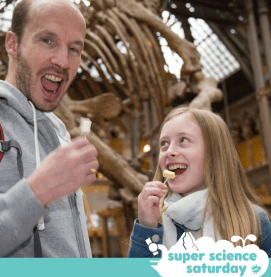
Come along to the museum for this fun family Science Fair, Saturday 27th November, 12-4pm.
Meet scientists and community organisations to learn more about current environmental research and projects.
Find out what scientists get up to and how they research the effects of our lifestyle choices on the planet and the things that live on it. Learn more about community larders and environmental projects that are working on creating a healthier planet. You can even try eating insects and decide if you think that’s the way forward to keep our planet healthy.
On the first floor of the Oxford University Museum of Natural History, at one end of the insect gallery, by the café, is an interactive screen. This displays one of my favourite parts of the insect gallery. The wonderful world of Microsculpture. This was originally an exhibition in the museum, Microsculpture: The Insect Photography of Levon Biss, which was open in 2016. You can still see the remarkable images from the exhibition on the screen in the gallery.
Interactive Microsculpture screen in the insect gallery
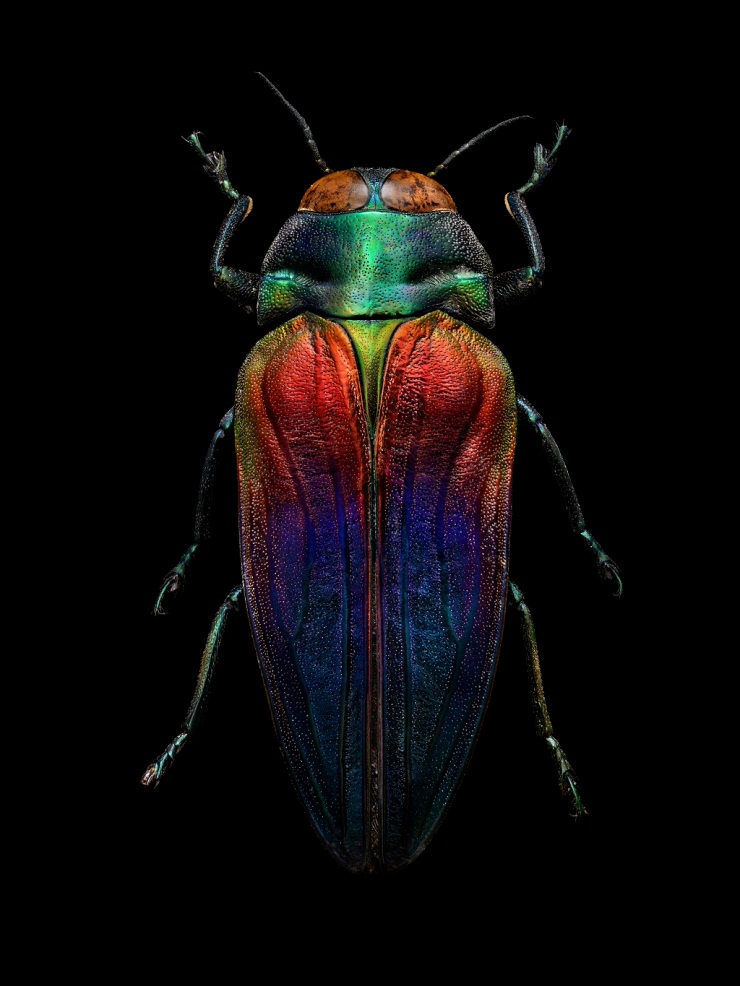
Microsculpture shows insect specimens from the Museum’s collection from a new angle. Photographer Levon Biss took a series of beautifully-lit, high magnification pictures showing striking high-resolution detail. Seeing the insects so close up lets you see colours and patterns that are difficult to see with the naked eye, particularly with very small insects. Seeing this detail makes me realise how beautiful they truly are. What do you think?
Tricolored Jewel Beetle (Belionota sumptuosa), collected by Alfred Russel Wallace in Seram Island, Indonesia. Length: 25 mm Image: Levon Bliss
Here is a video showing how the Microsculpture exhibition came about:
The Spotted Wing Fruit Fly, Drosphila suzukii, (known as ‘SWD’ for short) is a small but potentially devastating pest that attacks soft fruits. Here’s how to make a simple trap from a plastic bottle. You can then see if you have caught any fruit flies and send your results to an exciting citizen science project.
Making your Fly Trap
You will need:
A large empty clear plastic bottle (perhaps a fizzy drink bottle or squash bottle)
Apple cider vinegar (cheapest from a supermarket)
Washing-up liquid
String
Ruler
An auger, awl or large nail (2 mm to 3 mm diameter)
Start by watching this video by Chris Thomas of the Queckett Microscopical Club.It shows each step of making the fruit fly trap.
Step by step Instructions:
This bit needs an adult to help. Carefully pierce 8 holes in the bottle more than half way up, using the augur or nail. Lie the bottle on a table or board. Hold it firmly at the bottom half and gently pierce with a sharp metal point or augur, through the upper side of the bottle towards the board. If the point slips, it should then go safely into the table or board and NOT into your hand. Make the holes 2-3 mm in diameter, to let in small flies. I used a sharp augur to pierce the plastic and then a wider diameter nail to enlarge the hole.
Fill the upright bottle to ¼ to ⅓ with apple cider vinegar. The level must be below the holes!
Add one or two drops of washing-up liquid.
Screw lid back onto plastic bottle.
Use the string to hang your baited trap from a tree/bush/holder at a suitable place.
Leave the trap for one week.
At the end of the week, seal up holes with sellotape.
Swirl bottle gently and carefully pour the fly catch into a white / light coloured plastic dish. (OPTIONAL: strain the fly catch through an old metal tea sieve and then transfer the flies to clean water with a bit of vinegar in it to preserve them.)
Record your results (see below).
At the end of the experiment, wash and flush away the flies and liquid. Wash the plastic bottle thoroughly and recycle it. Don’t forget to wash your hands.
2021 Spotted Fruit Fly Survey
If you have caught some fruit flies, you could send your results to the 2021 Spotted Wing Fruit Fly Survey and help track the spread of this pest across the UK.
The Spotted Wing Fruit Drosophila (SWD) is a pest in many parts of the world because it causes damage to soft fruits. It was first spotted in the UK in 2012 and this survey aims to find out how far it has spread. Counting and scoring the results from your trap will be really helpful and we will link your results with those from many other people. The more people who contribute, the more we can learn about the biology of this pest.
Fruit flies are small – only a few millimetres long – but can be identified by a couple of key features with a hand lens, low power microscope, or by using a mobile phone camera (see below). The male flies are easily identified by their characteristic wing spot. The females don’t have the wing spot but do have a vicious-looking saw-like egg laying organ (called an ovipositor) at their rear end.
You might like to use your fruit fly trap to catch Spotted Wing Drosophila over a week, count what you have caught and send the results to Chris Thomas of the Quekett Club at bulletin@quekett.orgby the end of November.
The Club aims to collate all the results and publish them in the Quekett Journal, mentioning all participants who submit results.
Either use a magnifying glass or a low power microscope to magnify the catch. Don’t worry if you don’t have one – watch our video Turn Your Phone into a Microsope.
Fruit flies are very small, between 2 mm and 5 mm long. They are quite distinctive.
Use the pictures to help you identify the Spotted Winged Drosophila.
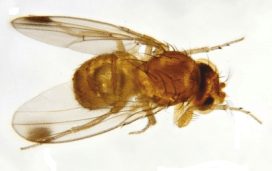
The male flies are obvious even to the naked eye – they are red-eyed fruit flies with a black spot at the end of the wing. Under magnification, they also have 2 spurs on their forelegs.
The female flies are best viewed under 10× to 30× magnification: they have no spots but their saw-like ovipositor (egg-laying organ) can be seen clearly. Once you have seen one, you will never be confused. They also have clear black and yellow bands on their abdomen.
Record your results and send them to the Quekett Club
You should include:
Name and address (or just your post code, if you don’t wish to be named as a participant)
Date when you emptied the fly trap
Total number of ALL insects/creatures in trap
Total number of ALL fruit flies
Number of male Spotted Wing Drosophila
Number of female Spotted Wing Drosophila
The Queckett club would love to see pictures of your catch, so please add them too
SEND YOUR RESULTS TO Chris Thomas at bulletin@quekett.orgby the end of November.
It’s really important to record and send in ALL results – even if you did not catch anything!
If you don’t catch anything, enter ‘Nothing’
If there are no Spotted Wing Drosophila, but you see other fruit flies, enter ‘Common Fruit Fly’
If you can’t decide if they are males or females, just tell us the total number of SWD
Make sure you send your survey results to Chris Thomas at the Quekett Club, but the team at Crunchy on the Outside would also like to see your fly traps and catches! Let us know how you got on by emailing us at hopelearning@oum.ox.ac.uk or using the Contact Us form.
Ashleigh Whiffin tells us about her work as Assistant Curator of Entomology at National Museums Scotland, as well as the slightly unusual way she first became interested in insects, leading to her pursuing a career in entomology.
Ashleigh mentions finding out that carrion insects can help solve crimes. How cool is that? Can you think of any other ways that insects help us? Let us know in the Contact us section of the blog.
Don’t forget to join us at the Museum this half term for some fabulous, free insect fun. We have a Science Show for you on Tuesday 26th October, and drop in activities on Monday 25th and Tuesday 26th October. Read on to find out more!
Insects: Bestie or Beastie? A Family Science Show
Join us for our brand new, interactive family Science Show on Tuesday 26th October at 2pm or 3.30pm. Find out what happens when an insect-phobic visitor to the museum meets a giant talking dung beetle! It promises to be a lot of fun! Tickets to the show are completely FREE but you do need to book.
On Tuesday 26th October, 1-4pm, Susie and Kate will be in the Museum main court with some fiendish insect challenges for you. Drop by and see if you can solve the puzzles with your insect intellect (no booking needed)!
Flower Power Drop-in Activities
Drop in on Monday 25th and Tuesday 26th October, 1pm – 4pm, for an afternoon of insect crafts, plus getting up close and personal with some fabulous insect specimens. No need to book; just drop-in!
Join us at the Museum this half term for some fabulous, free insect fun. We have a Science Show for you on Tuesday 26th October, and drop in activities on Monday 25th and Tuesday 26th October. Read on to find out more!
Insects: Bestie or Beastie? A Family Science Show
Join us for our brand new, interactive family Science Show on Tuesday 26th October at 2pm or 3.30pm. Find out what happens when an insect-phobic visitor to the museum meets a giant talking dung beetle! It promises to be a lot of fun! Tickets to the show are completely FREE but you do need to book.
Drop in on Monday 25th and Tuesday 26th October, 1pm – 4pm, for some insect fun in the museum main court with an afternoon of insect crafts, plus getting up close and personal with some fabulous insect specimens. No need to book; just drop-in!






 Crunchy on the outside