Raising Moths

Ben brought in some Poplar Hawk Moths to show the other participants at our recent summer school. Here he describes how he raised them from eggs he received as a gift from his grandfather.

Last year during lockdown my Grandpa gave me 32 hawk moth eggs: 30 eyed and two privet. Not the most common of presents you might think, but these turned into the most enjoyable gift. I was very excited as I tore open the parcel and found the eggs safely packed in a small tube. It took roughly a week for the leafy-green eggs to turn into the most delightful little caterpillars. I decided to call them all Jim. The first thing they went towards was the fresh willow that lay in a small, water-filled jam-jar.
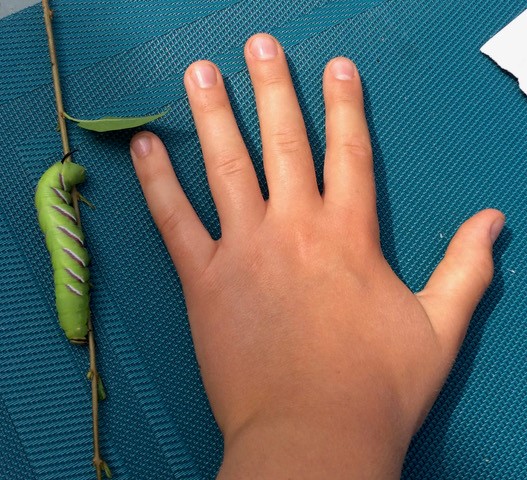
Poplar Hawk moth caterpillar with Ben’s hand for scale. Photo credit: Ben Atwell

Immediately, they started taking chunks the size of their heads out of the leaves until there were no leaves left inside the tank. I was very surprised by how much they ate in proportion to their size. Every day they grew bigger until, within 4 weeks, they were the length of my index finger! They were bright green with white stripes, pink spots and little pointy tails. To help them grow, they shed their skins every few days. Sadly, one little Jim got stuck in his skin whilst shedding and died. Willow-collecting took a lot of effort as it involved daily trips to the canal, but this was a welcome break from staring at my computer all day during online school.
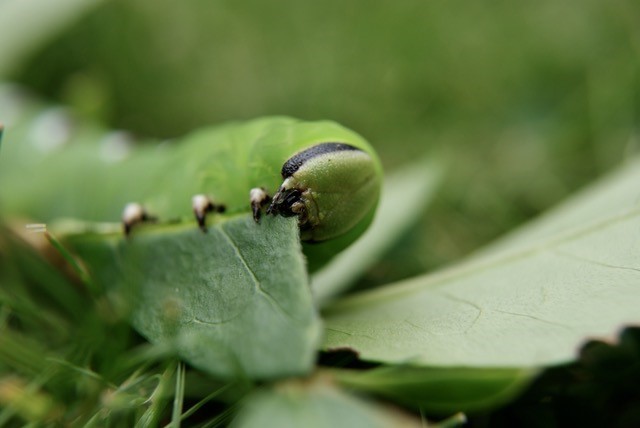
Poplar Hawk Moth larva feeding. Photo credit: Ben Atwell

One morning we found that a lot of the caterpillars were wandering around, banging their heads on the bottom of the tank. They were also turning a darker green which (after a bit of research) we found out meant they needed to bury and become a chrysalis. We put a deep layer of soil into the tank and within minutes they had disappeared. We tucked them up in the shed for winter and waited.

After months of hibernation, they started emerging this spring with crumpled wings, looking very like dead leaves. After stretching out their wings we noticed that we couldn’t see the eyes that the eyed hawk moths are known for, but as we later realised, they only show the eyes as a defence mechanism if they were under attack. Normally it would take a while for the males to seek out the females using their fanned antenna, but because they were in a large tank, it was easy for them to find each other and mate. Within a few days they had laid over 1,000 little green eggs! So, the process of willow collecting began again, but this time, after checking with the county moth recorder, we released the little caterpillars (who this year I called Jeff) into our local wildlife reserve, hoping that they survive and go on to repeat the process in the wild this year.

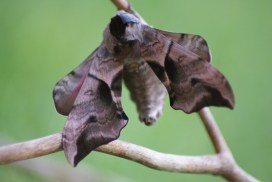
Poplar hawk Moth adult. Photo credit: Ben Atwell

We are still waiting for the privet chrysalises to hatch, but to keep me busy, my Grandpa sent me 15 poplar hawk moth eggs this spring. These have already been through one cycle of eggs-caterpillars-chrysalis-moth-eggs and I gave some of the eggs to the museum during the Insect Investigators Summer School. I hope the staff have time to collect all that poplar!

The Poplar Hawk Moth, Laothoe populi, is a beautiful insect found thrououghout the UK and is common wherever their foodplants can be found: mainly the poplar trees from which they get their name, aspen and willows. Ben describes the voracious appetite of the larvae well. The adults don’t feed at all and so are short-lived. You can find the adult moth from May to July and the caterpillars from June to October. In Southern England there may be a second generation of adults in the autumn.

a summer of insect activities

We are open!  After months of being closed due to the pandemic, Oxford’s Museum of Natural History finally reopened in May, and we are absolutely loving the fact that the museum is once again full of life, laughter and learning. 

If you live near Oxford, or are planning a trip to this part of the world, remember to visit us this Summer.  We would love to see you!  We have over 7 million historical and modern specimens, of which around 5 million are insects.  So, if you are interested in insects then this is the place to come!

Visiting the museum is FREE, but please book your tickets here Visit us | Oxford University Museum of Natural History

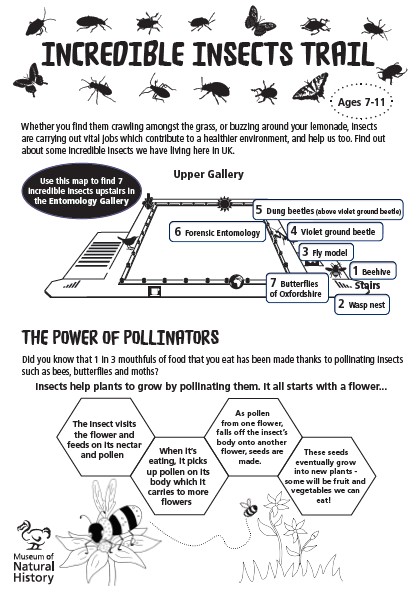
Why not try our Incredible Insects Trail?

Help yourself to a copy of this trail in the main museum court and journey round some of the highlights of our entomology collection. 

Take your completed trail to the front desk, mention that you heard about it here at crunchyontheoutside.com and you will receive a certificate and an Inspired by Insects badge. 

Remember to keep an eye on our website for information about other FREE Summer family activities in the museum. Events | Oxford University Museum of Natural History

Find us out and about in Oxfordshire

This Summer, we will also be out and about at the following events in Oxfordshire:

Out and About with Insects – Tuesday 17th August, 11am – 3pm, Princess Diana Park, Banbury

Finds us at Oxfordshire Play Association’s Play and Activity Day to learn more about insects and have a look at some of our magnificent specimens close up. Out and About with insects – Princess Diana Park, Banbury | Oxford University Museum of Natural History

Wychwood Forest Fair – Saturday 22nd August, 11am – 5pm, Foxburrow Wood, Witney

Come along and visit our stand where you will find a range of insect-related activities, including insect collecting using specialist equipment.  Find out more at: Wychwood Forest Fair | Wychwood Forest Trust

We would love to see you over the Summer, whether in the museum or out and about at an event. Have a fantastic Summer!

People: Karim Vahed

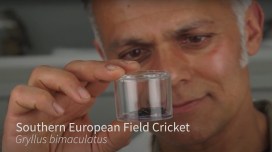
Professor Karim Vahed tells us about how he first became interested in insects and his work with Bush Crickets at the University of Derby. He explains what makes them so fascinating and why the Southern European Bush Cricket, Gryllus bimaculatus, is his favourite insect.

Professor Karim Vahed on why Bush Crickets are his favourite insect.

Do you have a favourite insect? What is it about it that you like? You can let us know using our Contact Us page.

If you enjoyed this video, you might like to take a look at others featuring scientists and other people who work with insects on our ‘People‘ pages.

Chafers

During the summer you may notice large beetles flying around in gardens and other green spaces. These insects are called ‘chafers’. While they may look similar, there are in fact several different species all known by this common name.

The name chafer comes from the Old English word for beetle, ceafor. It is similar to the modern German word for beetle, käfer. So, ‘chafer’ really just means ‘beetle’ but in English it came to be used for beetles that were particularly noticeable. Chafers got themselves noticed because they are large, the adults can fly and often emerge in large numbers at the same time of year, sometimes making a buzzing noise as they fly. They are attracted to lights, so often fly in open windows, then bump around the room trying to get out. Farmers and gardeners often think of them as pests because they can damage plants.

Chafers all have a similar life cycle. The larvae live in the soil or dead wood, often for several years. They are sometimes thought of as pests because they may feed on the roots and other parts of plants, but they are important recyclers, feeding on dead, decaying material and helping to return the nutrients it contains back into the soil. The larvae then pupate and survive the cold winter months in this form. The adults emerge in late spring, or summer, depending on the species. It may seem that large numbers of beetles have suddenly appeared out of nowhere, but in fact these adults have just emerged at the same time. The adult beetles mate and lay eggs which will become the next generation of larvae.

Cockchafer, Melolontha melolonta

The largest of the British chafers is the cockchafer (Melolontha melolontha). The adults emerge in late April or May, giving it another common name, the ‘Maybug’. They fly in a wobbly way and make a buzzing noise. This can make them seem a bit alarming but they are completely harmless to humans.

Cockchafers were once a huge agricultural pest and could emerge in such numbers that people were encouraged to eat them! A French recipe for cockchafer soup was published in the 1800s (https://en.wikipedia.org/wiki/Cockchafer_soup) and in the 1920s, German children were reportedly eating sugar coated cockchafers.

Pesticides brought this marvellous beetle to the brink of extinction in the UK during the last century. Now changes in agriculture and pesticide use mean that cockchafers are making a comeback and they can be found across England, although they still rarer in Scotland. The nationally much rarer Northern Cockchafer (Melolontha hippocastani) is found in Scotland, Northern England and Ireland.

The Summer Chafer (Amphimallon soltitiatis) looks a bit like the cockchafer, but is smaller, at about 20mm, and had a rounded, rather than pointed tail end . Traditionally, this beetle is associated with the Summer Solstice, or longest day of the year, because the adults often emerge in the second half of June. In fact, the Summer Chafer can be found all over Britain in June and July. Kate and Susie found lots of Summer Chafers on a visit to Orchard Meadow Primary School in Oxford on 23 June this year and have seen it in the grounds of several other schools we have visited.

Another similar beetle is the Welsh Chafer Hoplia philanthus which, despite its name, is not restricted to Wales, but also found in Southern England and the Midlands. It is smaller and less ‘hairy’ than the other chafers and can be recognised by the single large ‘claws’ on the end of its legs.

Welsh Chafer, Hoplia philanthus. Image Credit: Neil Stanworth

Eleanor and her father kindly sent us this picture of a Welsh Chafer they caught in their garden in the Midlands recently using a pitfall trap they made after watching Kate’s video from a few weeks ago. We’d love to see pictures of beetles and other insects you have found.

Some chafers are a striking green colour. One of these is the Rose Chafer (Cetonia aurata) which flies between May and October. Gardeners may consider it as a pest, particularly if they grow roses, because the beetles feed on their plants but, like the other chafers, these beetles are also important recyclers.

Noble Chafer, Gnorimus nobilis. Image credit: Flickr/Gail Hampshire CC BY 2.0

Another green chafer is the Noble Chafer (Gnorimus nobilis). You can tell the two apart because the Rose Chafer has smooth wing cases but the Noble Chafer has wrinkled ones and is metallic green with white speckles. While adult Noble Chafers feed on plants like hogweed, the larvae live in the decaying wood of old fruit trees. Because of this, the Noble Chafer is found in traditional orchards. As these have disappeared, so has this beautiful beetle which is now rare and a priority species under the UK biodiversity framework.

So, look out for chafers this summer and send us pictures of the ones you find. You may even come across one that’s quite rare!

Dr Andrew Salisbury

Dr Andrew Salisbury tells us a bit about his work at the Royal Horticultural Society (RHS), the world’s leading gardening charity. He also shares how he first became interested in insects, as a child.

He mentions a particular memory of an encounter with a Brown-tail moth caterpillar. Do you have any specific memories of insect encounters? Tell us about them in the comments below.

Make a pitfall trap

Try out a new technique for finding insects with HOPE Learning Officer, Kate.

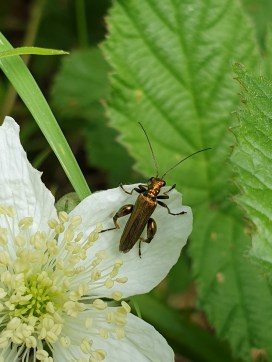
Have you found any interesting insects lately?  Along with the other HOPE Learning Officers, I have been out and about in Oxfordshire schools where we have found some fantastic insects.  Among my recent favourites is the thick-legged flower beetle, Oedemera nobilis

These beautiful beetles are distinctive with their stunning emerald-green colour and their chunky thighs which are seen only in the males.   We have also found lots of varied species of ladybird including cream spot, 14-spot and eyed ladybirds. Generally, we collect insects using sweep nets and beating trays but, of course, you might be lucky enough to find some interesting insects just by looking in the right places.  Under stones, logs, leaves, in amongst long grass or on flowers are all excellent places to start.  Insects, however, are very good at hiding so why not make a pitfall trap? This can be a great way to find a range of insects, particularly ground beetles.

Here are the written instructions.

You will need: 

  • A small pot such as a clean yoghurt pot
  • A trowel for digging
  • A few stones
  • A small piece of wood or a flat stone to act as a rain cover

What to do:

  1. Find a good spot for your trap on level ground, amongst vegetation.
  2. Dig a hole big enough to sink your pot so that it is completely level with the ground.
  3. Place the pot into the hole. You can put a few leaves, small stones and twigs in the pot to make any insects you catch feel at home.
  4. Build a cover over the trap by placing stones around the pot and resting a flat stone or piece of wood on top.  Make sure there is enough space for insects to crawl under.  This will stop the pot filling with water if it rains.
  5. Wait for a few hours or, better still, overnight.
  6. When you are ready, empty your pot carefully into a tray so you can see what has fallen in.  Take photos so that you can have a go at identifying what you have caught.
  7. Remember to check your pitfall trap every day and return any creatures carefully to a sheltered spot in vegetation.

We would love to know what you find! Let us know by commenting below or by using the Contact Us page.  Happy insect collecting!