Hunt for the Stag beetle

Here is the first contribution from one of our readers. It is a tale from Milo Dawes of his exciting hunt for a stag beetle in Richmond Park, London:

On Sunday 20th June I went to Richmond Park. It was a warm day and I had just been in the car for 45 minutes. When I got there, I saw lots of roe deer, but I had come here to find the biggest beetle in the UK – a greater stag beetle. Here is what you need to know to hunt stag beetles:

  • You should look on and around rotting wood and oak trees, especially where the wood has been chewed away.
  • Look in spiderwebs for dead lesser stag beetles – the greater stag beetles are strong flyers and can fly out of the webs.
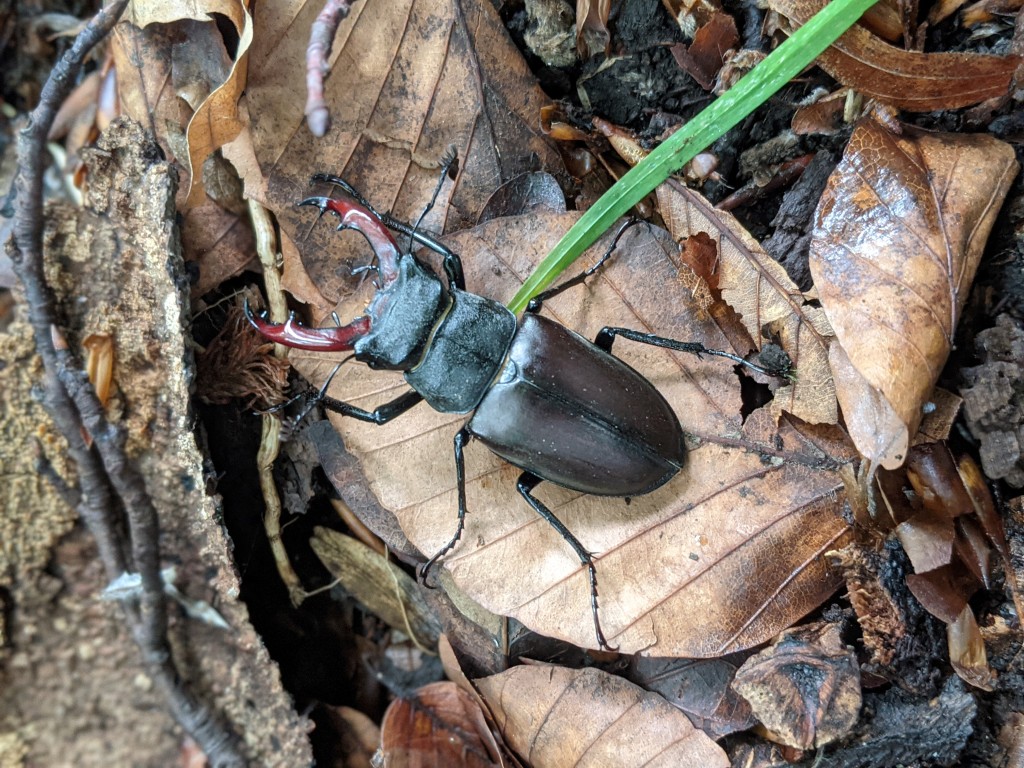
Stag beetle on dead leaves. Image credit: Dawes family.

Next to where I was looking there was a family of grazing deer, chewing away noisily. Slowly and quietly, I walked around some bramble to get to some rotting wood. I lifted it up, but found nothing. Sadly, I walked back, this time the other way around. I spotted something move next to the bramble, out of the corner of my eye. It was a greater stag beetle – the biggest I had ever seen.

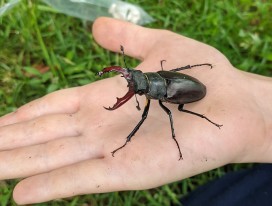
Greater stag beetles are often spotted flying around at dusk, flying with the tip of their jaws facing the sky, like a swordfish jumping out of the water. Males can grow up to 10cm – nearly as big as my hand. Greater stag beetles have a black head and thorax, reddish-brown antlers and a chestnut brown abdomen. They are endangered and rare because humans make life difficult for them. We build on woodland, and rotting wood is often removed from forests. They are being wiped out at an alarming rate. If you spot one, in London, you can help by going to www.wildlondon.org.uk to record your find.
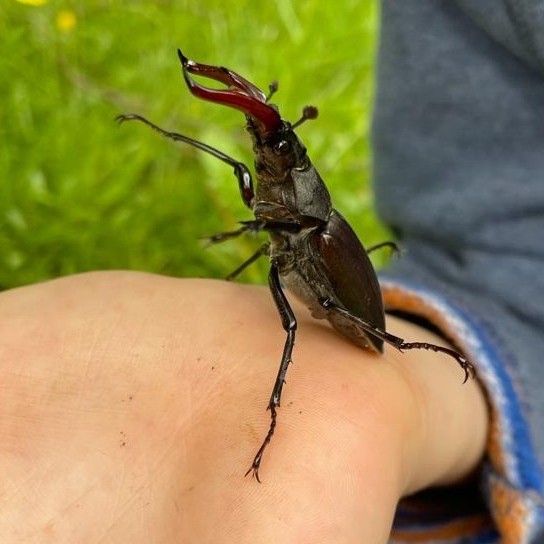
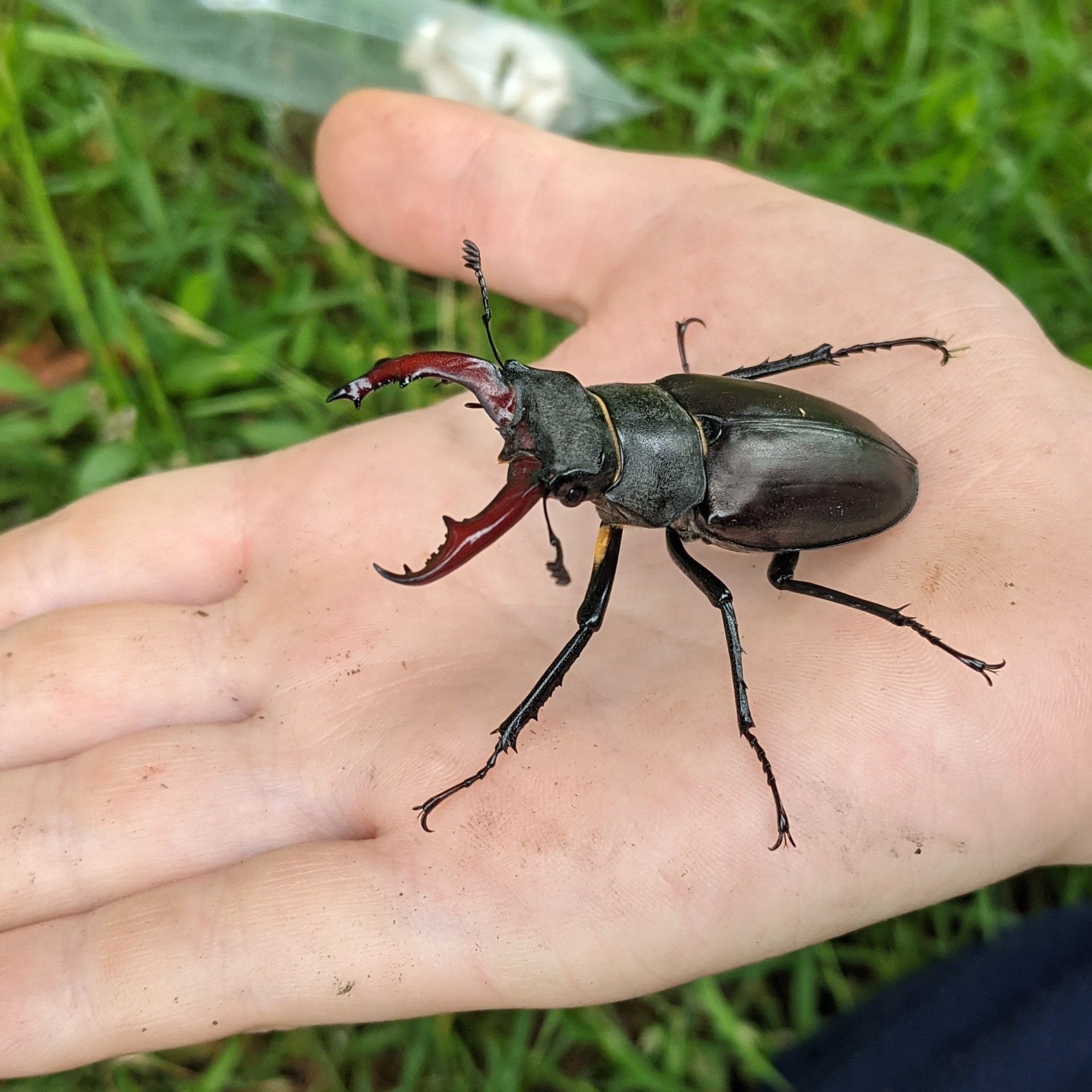
Stag beetle on hand. Image credit: Dawes family

I looked up above me, and there was an ancient oak tree looking very medieval. Then I looked at the stag beetle. It was right next to some rotting wood. I picked it up carefully and ran to a bench. Angrily, the stag beetle waved its antennae at me, and it may have even pointed at me with its claws. The beetle reared up. It was amazing.

Thank you to Milo for this fascinating account. If any of you would also like to write a piece on insects for the blog please contact us or email hopelearning@oum.ox.ac.uk.

Stag beetles are classed as a ‘priority species’, and are protected under the Wildlife and Countryside Act 1981. It is therefore important that you do not remove any from where they are found.
People: Karim Vahed

Professor Karim Vahed tells us about how he first became interested in insects and his work with Bush Crickets at the University of Derby. He explains what makes them so fascinating and why the Southern European Bush Cricket, Gryllus bimaculatus, is his favourite insect.

Professor Karim Vahed on why Bush Crickets are his favourite insect.

Do you have a favourite insect? What is it about it that you like? You can let us know using our Contact Us page.

If you enjoyed this video, you might like to take a look at others featuring scientists and other people who work with insects on our ‘People‘ pages.

Chafers

During the summer you may notice large beetles flying around in gardens and other green spaces. These insects are called ‘chafers’. While they may look similar, there are in fact several different species all known by this common name.

The name chafer comes from the Old English word for beetle, ceafor. It is similar to the modern German word for beetle, käfer. So, ‘chafer’ really just means ‘beetle’ but in English it came to be used for beetles that were particularly noticeable. Chafers got themselves noticed because they are large, the adults can fly and often emerge in large numbers at the same time of year, sometimes making a buzzing noise as they fly. They are attracted to lights, so often fly in open windows, then bump around the room trying to get out. Farmers and gardeners often think of them as pests because they can damage plants.

Chafers all have a similar life cycle. The larvae live in the soil or dead wood, often for several years. They are sometimes thought of as pests because they may feed on the roots and other parts of plants, but they are important recyclers, feeding on dead, decaying material and helping to return the nutrients it contains back into the soil. The larvae then pupate and survive the cold winter months in this form. The adults emerge in late spring, or summer, depending on the species. It may seem that large numbers of beetles have suddenly appeared out of nowhere, but in fact these adults have just emerged at the same time. The adult beetles mate and lay eggs which will become the next generation of larvae.

Cockchafer, Melolontha melolonta

The largest of the British chafers is the cockchafer (Melolontha melolontha). The adults emerge in late April or May, giving it another common name, the ‘Maybug’. They fly in a wobbly way and make a buzzing noise. This can make them seem a bit alarming but they are completely harmless to humans.

Cockchafers were once a huge agricultural pest and could emerge in such numbers that people were encouraged to eat them! A French recipe for cockchafer soup was published in the 1800s (https://en.wikipedia.org/wiki/Cockchafer_soup) and in the 1920s, German children were reportedly eating sugar coated cockchafers.

Pesticides brought this marvellous beetle to the brink of extinction in the UK during the last century. Now changes in agriculture and pesticide use mean that cockchafers are making a comeback and they can be found across England, although they still rarer in Scotland. The nationally much rarer Northern Cockchafer (Melolontha hippocastani) is found in Scotland, Northern England and Ireland.

The Summer Chafer (Amphimallon soltitiatis) looks a bit like the cockchafer, but is smaller, at about 20mm, and had a rounded, rather than pointed tail end . Traditionally, this beetle is associated with the Summer Solstice, or longest day of the year, because the adults often emerge in the second half of June. In fact, the Summer Chafer can be found all over Britain in June and July. Kate and Susie found lots of Summer Chafers on a visit to Orchard Meadow Primary School in Oxford on 23 June this year and have seen it in the grounds of several other schools we have visited.

Another similar beetle is the Welsh Chafer Hoplia philanthus which, despite its name, is not restricted to Wales, but also found in Southern England and the Midlands. It is smaller and less ‘hairy’ than the other chafers and can be recognised by the single large ‘claws’ on the end of its legs.

Welsh Chafer, Hoplia philanthus. Image Credit: Neil Stanworth

Eleanor and her father kindly sent us this picture of a Welsh Chafer they caught in their garden in the Midlands recently using a pitfall trap they made after watching Kate’s video from a few weeks ago. We’d love to see pictures of beetles and other insects you have found.

Some chafers are a striking green colour. One of these is the Rose Chafer (Cetonia aurata) which flies between May and October. Gardeners may consider it as a pest, particularly if they grow roses, because the beetles feed on their plants but, like the other chafers, these beetles are also important recyclers.

Noble Chafer, Gnorimus nobilis. Image credit: Flickr/Gail Hampshire CC BY 2.0

Another green chafer is the Noble Chafer (Gnorimus nobilis). You can tell the two apart because the Rose Chafer has smooth wing cases but the Noble Chafer has wrinkled ones and is metallic green with white speckles. While adult Noble Chafers feed on plants like hogweed, the larvae live in the decaying wood of old fruit trees. Because of this, the Noble Chafer is found in traditional orchards. As these have disappeared, so has this beautiful beetle which is now rare and a priority species under the UK biodiversity framework.

So, look out for chafers this summer and send us pictures of the ones you find. You may even come across one that’s quite rare!

Insect investigators Summer School

This post was first written in June 2021. The summer school is now full and booking has closed. You can find lots of insect activities on the Museum of Natural History webpages for our 2020 virtual Six Legs of Summer summer school.

We are very excited to announce that we will be running an Insect Investigators summer school at the Museum of Natural History during the week 2 – 6 August 2021.

If you are aged between 10 and 14, discover the amazing world of beetles, bees and butterflies at our free Insect Investigators Summer school, 10am to 3pm on 2nd6th August 2021.

The summer school will be for 10-14 year olds and is free of charge, thanks to generous funding from the National Lottery Heritage Fund. Those taking part will gain a behind the scenes insight into the British Insect Collection and the work of museum, photograph insects at the Botanic Gardens with a wildlife photographer, learn how entomologists collect and study insects with practical sessions at Harcourt Arboretum, and carry out their own insect investigation. Perhaps you’ll even have an insect added to the collection!

Past summer school participants have added to the British Insect Collection

If you would like to know more, or want to book a place, please get in touch using the Contact Us page, or email Rodger, Susie and Kate at hopelearning@oum.ox.ac.uk. We’re looking forward to hearing from you!

Cartooning with Chris

Here at Crunchy on the Outside we love insects and we also love cartoons. What could be better, then, than cartoon insects?!

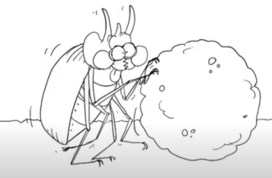
In this video Chris Jarvis shows us how to draw a mighty dung beetle called the Minotaur Beetle (Typhaeus typhoeus) complete with its own ball of dung!

Minotaur beetles grow to about 2cm in length and can be seen between September and July. They live in grassland and heathland with sandy soils. They feed on rabbit droppings and other dung (yum!) which they roll into balls and bury them in nests which can be over a metre deep underground. Male beetles may defend these nests using their long horns. The females lay their eggs in these nests. The eggs then hatch and the larvae feed on the tasty dung!

Watch the video carefully and you will see that Chris has included many of the key features of this fascinating beetle. He has deliberately left one insect feature out of his drawing. Can you spot what is missing? Here’s a clue: they help insects sense their environment.

Let us know what you think is missing by commenting below, or sending us a message using the Contact Us page. We’d also love to see you own cartoon insects!

Helen Roy’s Favourite Ladybirds

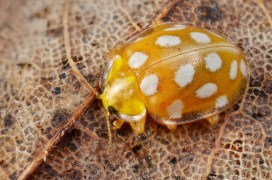
Professor Helen Roy, President of the Royal Entomological Society, tells us about a group of insects that interest her most: ladybirds. Also known as ladybugs, ladybirds are in fact beetles. In this video, Helen shares three of her favourites.

Helen Roy shares her favourite ladybirds

Which ladybirds have you spotted? Can you find any of Helen’s favourites? Do you have a favourite of your own? Let us know in the comments section below, or send us a message via the Contact Us page.

Ladybird images credit: Flickr / Gilles San Martin CC BY-SA 2.0