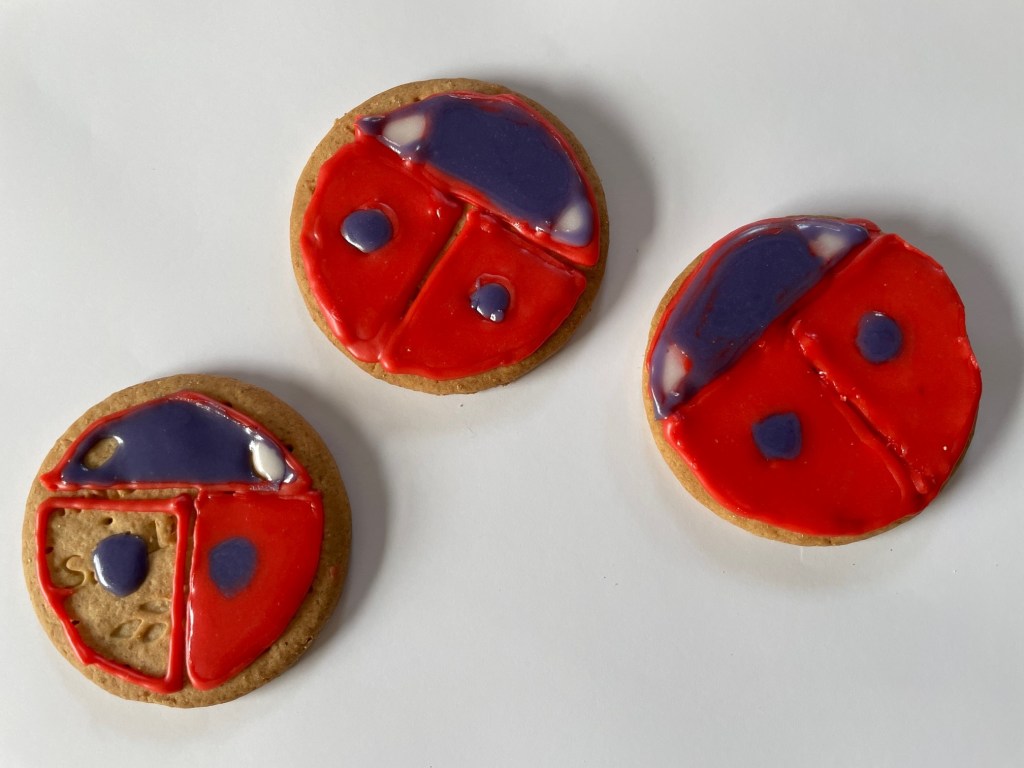
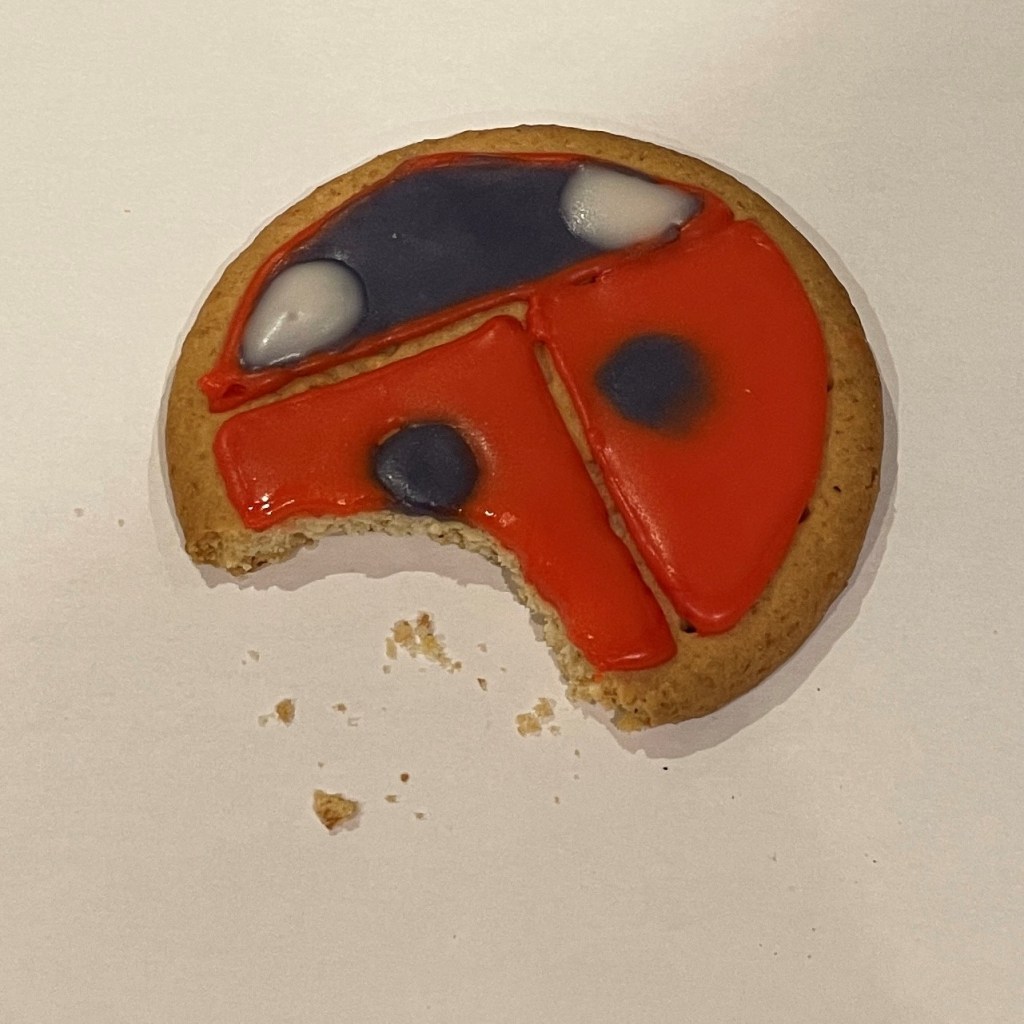
Enjoy biscuits? Like beetles? Then you’ll love our iced beetle biscuits! We have designed ours to look like ladybirds, but you can decorate yours in any way you like. If you haven’t got time to bake the biscuits you could buy some and decorate them.
You will need:
Round biscuit cutter
Baking tray – lightly greased or with baking paper
Mixing bowl
Rolling pin
Wooden spoon
teaspoon
A work surface sprinkled with flour
A wire rack to cool the biscuits
Oven pre-heated to 190oC (170oC if its a fan oven)
Oven gloves
A grown-up assistant
Ingredients:
100g butter – take it out of the fridge to soften it
225g self-raising flour
80g caster sugar
1 large egg, beaten
1 tablespoon of milk
3 drops of vanilla extract
To make the icing:
100g icing sugar
1 tablespoon of lemon juice (use water if you haven’t got juice)
Food colouring – colours of your choice
How to make the biscuits:
Wash your hands. Make sure your assistant washes theirs too.
Lightly grease the baking tray.
In the mixing bowl, rub the butter into the flour using your fingertips. Keep going until the mixture looks like breadcrumbs.
Add the sugar, beaten egg, milk and vanilla extract.
Mix all the ingredients together in a bowl. You can use the spoon to start but as the dough forms you will probably find it easier to use your hands to shape it into a ball.
Using the rolling pin, roll out the dough on the floured work surface until it is spread out in a thin layer.
Cut out biscuit shapes from the dough and put them on the baking tray.
Bake in the oven for 10-15 minutes. Ask your assistant to take them out when they are golden brown.
Cool the biscuits on the wire rack. watch that your assistant doesn’t try to snaffle the warm biscuits!
How to make the icing:
While the biscuits are cooling, mix the icing ingredients. The icing needs to be liquid but not so runny that it runs off the biscuit when you put it on. If it’s too runny, add a bit more icing sugar. If its too stiff, add a drop of water. Divide your icing between bowls, one for each colour you are using. For the biscuits in the picture, we used red and violet and also kept some white icing. Add a drop of food colour to each bowl and mix it in. When the biscuits are cool, use the teaspoon to spoon a little icing onto each biscuit, then smooth it on with the back of the spoon. You can use a cocktail stick to spread out small amounts of icing.
Top tip: if you have a piping bag, you can stop the colours mixing into each other, pipe the outline of the parts of your beetle, let that icing dry, then fill in with more liquid icing.
We hope you enjoy your biscuits! Why not send us a picture of your design for our Photo Gallery?
Our next event for young entomologists, aged 10-14, will be ‘The Big Draw: Insects!‘ on Wednesday 26 October 2022, 10.30am – 12pm at the Museum of Natural History in Oxford.
Timed to coincide with the half-term break for local schools and to link in with other ‘Big Draw’ events in October, The Big Draw: Insects! is your chance to try your hand at drawing insects in three different styles: artistic, scientific and cartooning.
We’ll be based in the newly-refurbished Westwood Room at the museum and will be drawing a range of exciting insects from the museum’s collections. This event is suitable for all abilities from beginners to those who already enjoy drawing frequently.
The Big Draw: Insects! is free but you need to book in advance by emailing us at hopelearning@oum.ox.ac.uk
If you’re interested in cartooning, you might be interested in this post by Chris Jarvis on Drawing a Minotaur Beetle.
If you look at any ivy during the autumn there is a good chance that you will see bees on the flowers. They may look like honey bees but they are more likely to be the Ivy Mining Bee (Colletes hederae), which has a very different way of living.
Ivy Mining Bees feeding on ivy
Ivy Mining Bees can be seen feeding on ivy in late summer and early autumn, when it is in flower. Large numbers of these bees are attracted to the flowers and, because the females look very like honey bees, people sometimes think that they are all sisters from the same hive. In fact, the Ivy Mining Bee is quite different type of bee. They are a solitary species and each bee will have come from from its own individual nest.
Ivy Mining Bees are the last of the solitary bees to emerge each year, right at the end of summer when ivy is flowering. If you live in Southern England, they will probably be a familiar sight. You may not have seen them if you live further north because this bee is a relative newcomer to the UK. They were first seen on the south coast in 2001 and have since spread northward throughout England and Wales.
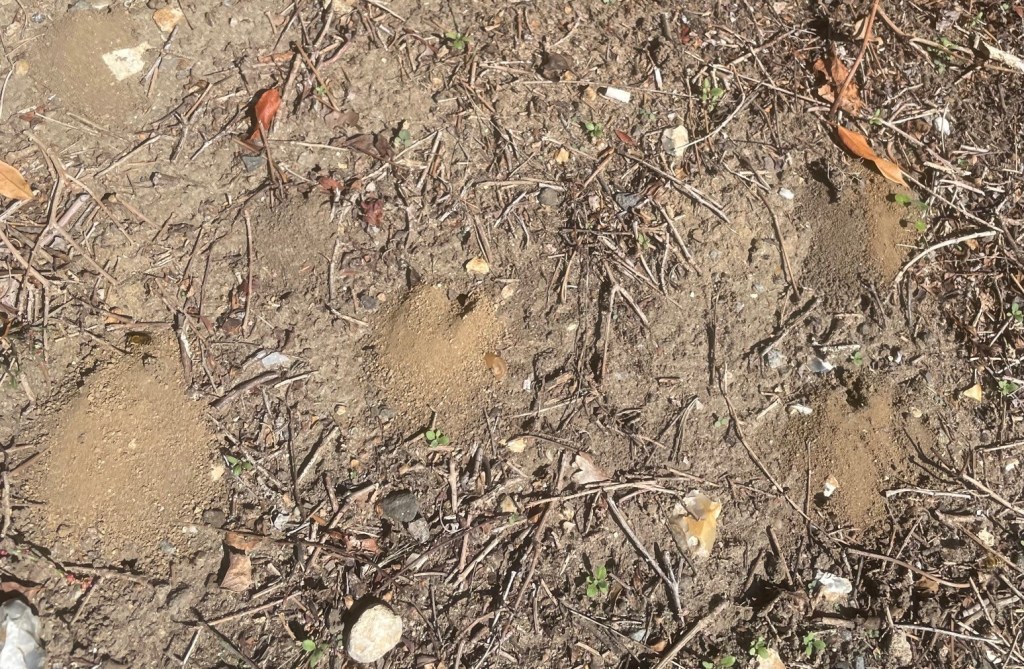
Ivy Mining Bee nests are often close together
These bees build their nests underground, preferring to burrow into bare ground on south-facing slopes, which is how they get the ‘mining’ part of their name. They like patches of bear earth but may also nest in garden lawns and vegetable patches. Although solitary, they like to build their nests together, so the ground can be pockmarked with dozens or even hundreds of tiny volcano-like burrow entrances.
The males emerge first and compete with each other to mate with female bees. Often several males will cluster round a single female bee. Females excavate underground burrows. In the video, you can see a female bee carrying soil out of the burrow and moving it away from the entrance with her legs.
Female Ivy Mining Bee excavating her nest.
The female bees then lay their eggs in the burrows they have made. They overwinter in these burrows, protected from the coldest temperatures. The new generation will then emerge the following year
Identifying the Ivy Mining Bee
Female bees are about the same size as honey bees and can be slightly larger. They also have similar colouration to honey bees but have dense ginger hairs on their thorax and very distinctive orange/yellow stripes on their abdomen. The males are smaller and are very similar to other closely-related Colletes species. This makes them difficult to tell apart from other species, but if you spot a bee on ivy in early autumn, it’s probably the Ivy Mining Bee.
If you enjoyed this post you might like to read about the Red-tailed Mason Bee. If you have spotted any bees out and about this autumn, why not ley us know via our Contact Us page?
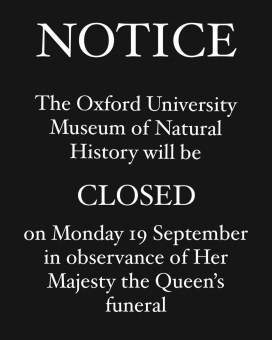
The Oxford University Museum of Natural History will be closed on Monday 19 September in observance of the bank holiday for Her Majesty the Queen’s state funeral.
The Museum will reopen at 10am on Tuesday 20 September.
If you have visited the Museum lately you may have noted some changes. Some sections have been closed and some mysterious sounds have been heard from behind the boards that hide the view. What is going on?
Well, some exciting changes are coming! The main court is being revitalised with the first major redisplay of the permanent exhibitions for over 20 years. Visitors will be able to experience our collections like they never have done before, with new displays showcasing Life, as we know it.
The new displays will focus on the interaction between the changing geology of our planet with how life has evolved on Earth. Our new exhibits will trace the story of life on Earth and celebrate our planet’s incredible diversity of life. They will also encourage visitors to think about the future, as well as the past. We want to inspire our 750,000+ yearly visitors to take action to help preserve global biodiversity.
Artist’s impression of how some of the new displays will look
You may have already seen the first phase of Life, as we know it. In 2018 our Out of the Deep displays were installed. The work going on now is Phase 2 of the project and we will be continuing work on Life, as we know it over the next few years, with plans to update exhibits that extend throughout the Museum.
Out of the Deep
Things might look a bit unfinished at the moment, but were doing our best to keep disruption to a minumum. Right now, you can get an exciting glimpse of the displays as they come together, including new insect exhibits. Later in the Autumn you’ll be able to enjoy the finished results!
Have you seen anything new in the Museum? Let us know by getting in touch using our Contact Us page.
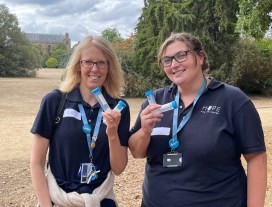
Kate Jaeger and Susie Glover have been Learning Officers at the heart of the HOPE For The Future project since the programme started in 2020. As their time with the project draws to an end, they reflect on their exciting role, what they enjoyed most about it, and choose their favourite insects from the many they encountered.
There are three HOPE Learning Officers and one Community Officer working on the project. We all help people learn more about insects and the museum’s collections, inspiring them to learn more, and even get more involved.
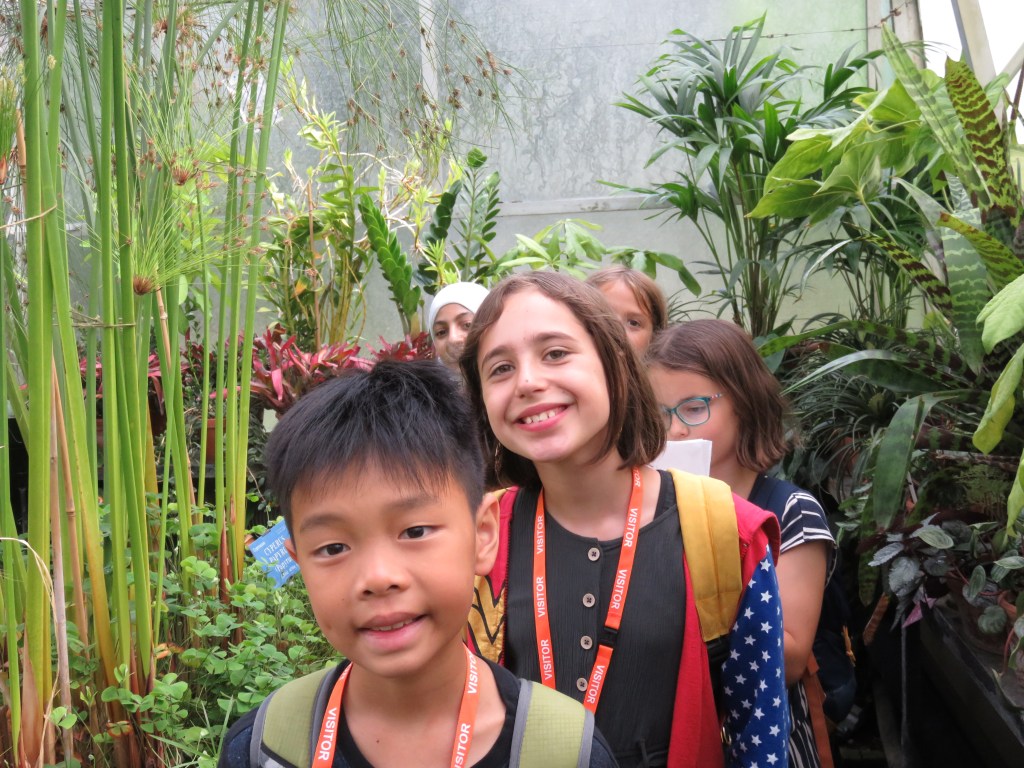
The learning officers work with young people. You may have met us at school, at an event in the museum, or you may have read an article like this in the blog. Our role includes running insect themed activities:
Insect Discovery Days in Schools
Insect Investigators Summer School
Insect Explorers after school club in the museum
Events for young people
Training for teachers to help them teach about insects
Of course, we also run this blog aimed at young people who want to learn more about insects, as well as developing various online resources for teachers and young people to use, and enjoy.
When did you first become interested in insects?
Kate:
I have always loved the natural world. As a child, I lived in the countryside and my pockets were often full of things I had collected such as stones, seeds, sticks and, once, much to my mother’s surprise, a live mole! I was especially fond of butterflies and had an I-Spy book in which I ticked off species I had seen. Soon other books on insects, birds, fossils, minerals, dinosaurs and human evolution filled my shelves.
This interest in the natural world stayed with me into adulthood and when I became a teacher, I trained as a Forest School Leader so that I could share my love of the outdoors with others. Working on the HOPE for the Future project has given me a unique opportunity to indulge my passion and learn much more about insects from the incredible entomology team here at the museum. The more I find out about insects, the more fascinated I become! The insect world is full of surprises and I am constantly amazed by these tiny creatures, without whom our planet Earth would not be able to survive.
Susie:
As a child I loved being outside, climbing trees, digging holes, investigating the different creatures in my back garden, and generally being surrounded by natural and wildlife.
I did well in school, but was particularly good at Biology. It just made sense to me, and I found it really interesting, and so I went on to study it at University. While biology is a fairly broad subject, I focused mainly on ecology, animal behaviour and evolution, learning more about the creatures all around us, including insects.
I have worked for several years teaching people about Nature and British Wildlife, including British insects, and always found them interesting. However, it wasn’t until I started my role here at the museum, working on the HOPE for the Future project that I really focused in on insects. Over the past couple of years I have learnt so much more about these fascinating creatures, and the multitude of different ways they find to survive and thrive.
What is your favourite insect?
Kate:
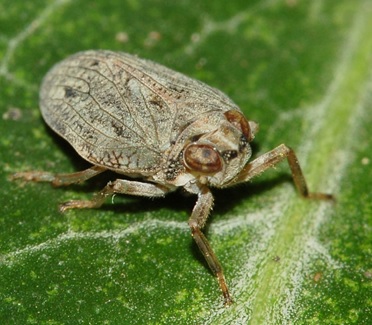
My favourite insect is constantly changing, but at the moment I am keen on this little true bug: Issus cleoptratus.
Issus cleoptratus. Image credit: Fritz Geller-Grimm, CC BY-SA 2.5
Not the most beautiful of insects but a fascinating one nonetheless! This species of plant hopper is the first living creature known to possess functional, interlocking gears or cogs. These gears are positioned on its hind legs and help to synchronise the legs when jumping, making sure the bug can hop in a straight line!
Check out this video which explains it all:
Working gears evolved in plant-hopping insects. Scientific American.
See what I mean about the insect world being full of surprises?
Susie:
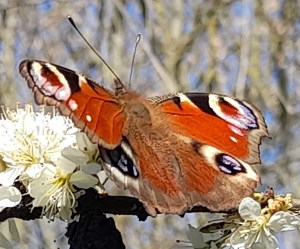
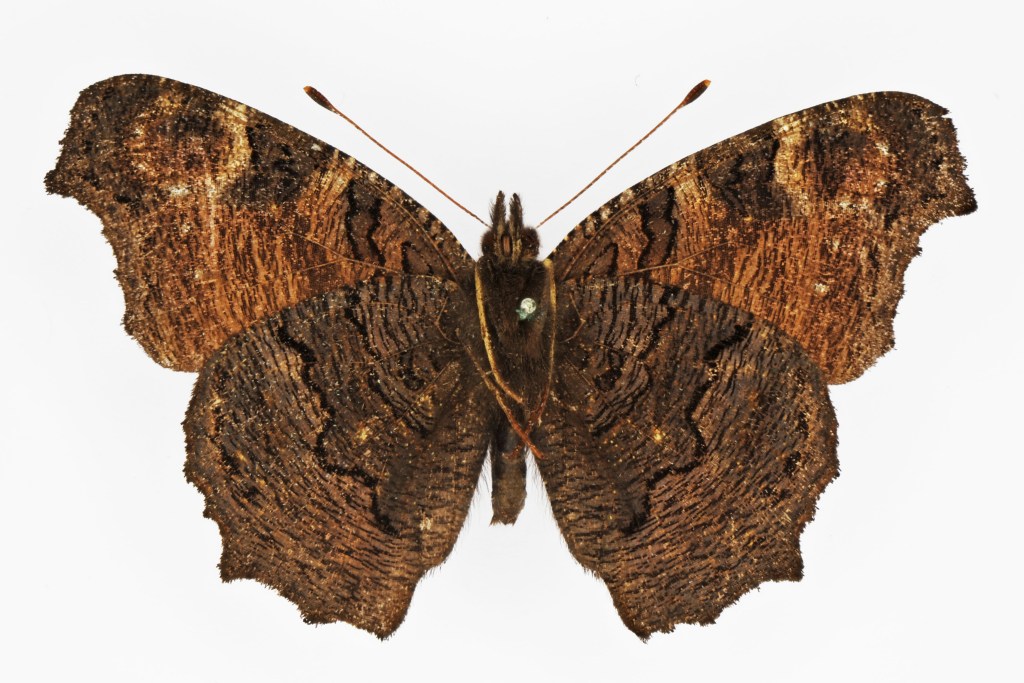
I have always loved butterflies. They are such beautiful majestic creatures. When I see the first butterflies of the year, which are often the bright yellow brimstone butterflies, I feel that winter is over and summer is truly on the way. However, I think my favourite has to be one of the most common garden butterflies in England and Wales, the Peacock Butterfly (Aglais io).
The Peacock Butterfly, Aglais io
To protect themselves these butterflies use a combination of camouflage and Mimicry. When at rest they sit with their wings closed, so that all you can see are the almost black undersides of their wings that look rather like dead leaves. But when their wings are open, you can see the brightly coloured top side of the wings, with large round spots, that look like large eyes. These eyespots are there to startle and confuse predators.
What is your favourite part of the project?
Kate:
Well, I have had the privilege to work in one of the world’s most fascinating museums, with one of the best entomology collections in the UK and with some very interesting people. I particularly enjoyed creating the ‘To Bee or not to Bee’ activity in which you have to identify the real bees among the bee mimics. It has proved a hit with all ages, from young children to seasoned entomologists, and we hope to produce an online version to bring it to a wider audience. The thing I have enjoyed most, though, is meeting hundreds, if not thousands, of young people through the course of the project, both here in the museum and in their schools. Their interest and enthusiasm for insects and the natural world has really given me hope for the future.
Susie:
I love coming up with new activities to help people learn about insects and the world around them. There are three activities that I particularly enjoyed developing:
The Case of the Stolen Specimen – this was for an event for 10 to 14 year olds. We developed a puzzle for the young people to solve. A Specimen had been stolen from the museum and they had to solve puzzles and follow clues to find out what had been stolen, and who the thief was. It was great to see how much the participants seemed to enjoy working out the clues and rushing off to solve the crime.
Food Chains – this was an activity for the Discovery Days, that is now also available online for teachers to use. It is made up from a series of cards which each have a photo of an animal on one side (mostly insects), and information about what they eat on the other. You have to use this information to build food chains and webs.
Peppered Moth – this was also an activity for the Discovery Days. The participants have to put on glasses, which distort their vision, and then use tweezers to pick up as many “moths” as they can in a certain time. They can see which moths they pick up, and how the colour of the moth and background affected this.
We wish Kate and Susie all the best for their future as school teachers. If you have enjoyed this post, you might like to read about other people who work with insects on our ‘People’ section.







 Crunchy on the outside